
Best Airbrush Primer (2026): Vallejo, Stynylrez and AutoBorne Compared
The best airbrush primer for models, miniatures, 3D prints and hard surfaces, compared on surfaces, thinning and spraying pressure from the makers.
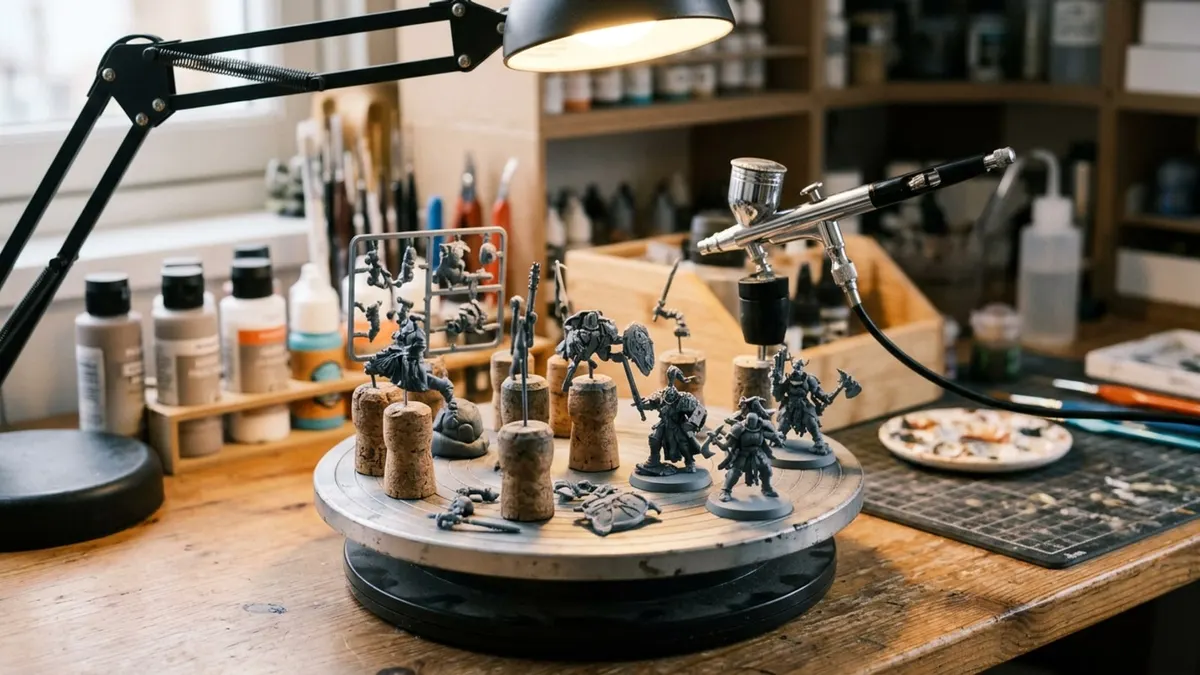
Affiliate disclosure: product links on this page go to Amazon, or to the maker's own store for brands that sell only direct. As an Amazon Associate we earn from qualifying purchases, at no extra cost to you; a link to a maker's store earns us nothing. No retailer or brand sees our picks before they are published or has any say in them. How we choose.
For models and miniatures the best airbrush primer is Vallejo Surface Primer: water-based, not flammable, sprayed straight from the bottle at about 15 to 20 psi, and rated by Vallejo for resin, PVC, brass, white metal and wood. Badger Stynylrez is the alternative, sold as a water-based acrylic polyurethane that levels itself and dries hard and flat. For helmets, panels and 3D prints, Createx's AutoBorne Sealer is a primer-sealer built for hard surfaces.
All three are water-based and clean up with water, which makes them practical indoors with a spray booth. Below: what each maker says it sticks to, how to thin it and the pressure to spray.
Our top picks at a glance
1. Best for models and miniatures
Vallejo Surface Primer grey (200 ml)Base: Water-based acrylic · Surfaces: Resin, PVC, brass, white metal, wood · Thinning: Use directly, or dilute with Airbrush Thinner or Flow Improver · Pressure: About 15 to 20 psi
2. Best self-leveling alternative
Badger Stynylrez 3-tone primer set (SNR-410)Base: Water-based acrylic polyurethane (per the Amazon listing) · Surfaces: Plastics, metals, wood, resin (per the Amazon listing) · Thinning: Not stated on the listing · Pressure: Not stated on the listing
3. Best for helmets, panels and 3D prints
Createx AutoBorne Sealer 6001 white (8 oz)Base: Water-based acrylic resin · Surfaces: Aluminum, plastic, fiberglass, wood, PLA, ABS, nylon, resin, ceramic, polycarbonate · Thinning: 4011 Reducer 5 to 10% (up to 20% for airbrush) · Pressure: 25 to 30+ psi, 0.5 mm or larger tip
| Pick | Base | Surfaces | Thinning | Pressure | Buy |
|---|---|---|---|---|---|
| Vallejo Surface Primer grey (200 ml)Best for models and miniatures | Water-based acrylic | Resin, PVC, brass, white metal, wood | Use directly, or dilute with Airbrush Thinner or Flow Improver | About 15 to 20 psi | Amazon |
| Badger Stynylrez 3-tone primer set (SNR-410)Best self-leveling alternative | Water-based acrylic polyurethane (per the Amazon listing) | Plastics, metals, wood, resin (per the Amazon listing) | Not stated on the listing | Not stated on the listing | Amazon |
| Createx AutoBorne Sealer 6001 white (8 oz)Best for helmets, panels and 3D prints | Water-based acrylic resin | Aluminum, plastic, fiberglass, wood, PLA, ABS, nylon, resin, ceramic, polycarbonate | 4011 Reducer 5 to 10% (up to 20% for airbrush) | 25 to 30+ psi, 0.5 mm or larger tip | Amazon |
Best for models and miniatures
Vallejo Surface Primer grey (200 ml)
The easiest primer to airbrush indoors: ready to spray, low pressure, not flammable, in many colors.
- Base
- Water-based acrylic
- Surfaces
- Resin, PVC, brass, white metal, wood
- Thinning
- Use directly, or dilute with Airbrush Thinner or Flow Improver
- Pressure
- About 15 to 20 psi
Pros
- Sprays from the bottle at low pressure
- Not flammable and contains no solvents, per Vallejo
- Keeps fine detail, per Vallejo
- Many colors, including black, white, grey and military shades
Cons
- Needs several thin coats and a few hours to cure
- Vallejo gives no thinning ratio for it
Vallejo describes Surface Primer as the first color layer of a model: it preserves the smallest detail and improves adhesion of the colors applied over it. Its primers page rates it for resin, PVC, brass, white metal and wood, says to apply it in several layers, and says it forms a homogeneous film of strength and resistance within a few hours. Use it directly or diluted with Vallejo Airbrush Thinner or Flow Improver, at around 15 to 20 psi, and clean up with Vallejo Airbrush Cleaner.
Prepare the part the way Vallejo's Model Air chart describes: wash it with neutral soap so the surface is degreased before priming. The black suits dark schemes and zenithal highlighting; the white suits bright colors.
Best self-leveling alternative
Badger Stynylrez 3-tone primer set (SNR-410)
A water-based acrylic polyurethane primer sold as self-leveling with a hard, flat finish, in a three-color starter set.
- Base
- Water-based acrylic polyurethane (per the Amazon listing)
- Surfaces
- Plastics, metals, wood, resin (per the Amazon listing)
- Thinning
- Not stated on the listing
- Pressure
- Not stated on the listing
Pros
- Self-leveling, dries to a hard flat finish (per the Amazon listing)
- White, gray and black in one set
- Made in the USA (per the Amazon listing)
Cons
- Badger's own website is under renovation, so there is no maker data sheet online
- The listing warns freezing in transit can ruin it
Badger's Stynylrez is sold as a water-based acrylic polyurethane primer that levels itself and dries to a hard, flat finish on plastics, metals, wood and resin (per the Amazon listing). Badger's Patriot 105 listing names Stynylrez among the materials that airbrush sprays. The three-tone set gives white, gray and black in 4 oz bottles.
The drawback is information. When we checked on Nov 8, 2026, Badger's website said it was still under renovation and showed no product or data sheets, so there is no maker figure for thinning or pressure to quote. If you use it, start at the bottle, spray light coats and test on scrap. The listing also warns that the primer can become unusable if it freezes, so avoid ordering it into a cold-weather delivery.
Best for helmets, panels and 3D prints
Createx AutoBorne Sealer 6001 white (8 oz)
Createx's sealer-primer for hard surfaces, with a data sheet that covers plastics, fiberglass, wood and 3D print materials.
- Base
- Water-based acrylic resin
- Surfaces
- Aluminum, plastic, fiberglass, wood, PLA, ABS, nylon, resin, ceramic, polycarbonate
- Thinning
- 4011 Reducer 5 to 10% (up to 20% for airbrush)
- Pressure
- 25 to 30+ psi, 0.5 mm or larger tip
Pros
- Createx calls it its most adhesive coating
- Rated direct to most substrates except silicone
- Opaque in 2 to 3 coats; recoat in 5 to 10 minutes, per Createx
Cons
- Needs a 0.5 mm or larger airbrush
- Bare metal needs a 2K epoxy or urethane primer first, per Createx
AutoBorne is Createx's sealer-primer: the starting ground coat for hard surfaces in its basecoat and clearcoat process, and the most adhesive coating Createx makes, per its hard-surface guide. The data sheet lists aluminum, plastic, fiberglass, wood, 3D print materials (PLA, ABS and nylon), urethane resin, ceramic and polycarbonate, and says it can go directly onto any substrate except silicone. For metal, Createx says to use a 2K epoxy or urethane direct-to-metal primer.
Thin it with 4011 Reducer at 5 to 10% (up to 20% through an airbrush), let it sit 10 minutes, and spray through a 0.5 mm or larger tip at 25 to 30 psi or more. Createx says it covers opaque in two or three coats and can be recoated in 5 to 10 minutes. Scuff the surface with 400 to 800 grit and wipe it clean first.
The data sheet's times are for 70°F and 50% relative humidity: let each coat dry matte before the next, and allow 20 to 30 minutes before Createx paint goes on. There is no recoat window, so color can follow at any time without scuffing. Rinse the airbrush with warm water and 4011 between colors, and use 4008 Restorer as the final clean.
The picks side by side
| Primer | Best on | Thin with | Pressure | Nozzle |
|---|---|---|---|---|
| Vallejo Surface Primer | Plastic, resin, metal and wood models | Vallejo Airbrush Thinner or Flow Improver, optional | About 15 to 20 psi | Not stated |
| Badger Stynylrez | Plastic, metal, wood, resin | Not stated | Not stated | Not stated |
| Createx AutoBorne Sealer | Helmets, panels, 3D prints, fiberglass | 4011 Reducer, 5 to 10% (up to 20%) | 25 to 30+ psi | 0.5 mm or larger |
Surface prep by material
| Surface | Prep, per the makers | Primer |
|---|---|---|
| Plastic, resin and PVC models | Wash with neutral soap to degrease (Vallejo) | Vallejo Surface Primer or Stynylrez |
| White metal and brass | Degrease | Vallejo Surface Primer (Vallejo lists both) |
| Bare automotive metal | Clean and scuff | A 2K epoxy or urethane direct-to-metal primer first, then AutoBorne (Createx) |
| 3D prints (PLA, ABS, nylon) | Scuff 400 to 800 grit and wipe clean (Createx) | AutoBorne Sealer |
| Wood | Clean and dry | Vallejo Surface Primer or AutoBorne |
Which color primer?
Vallejo sells its Surface Primer in a range of the basic shades most used to prepare models and miniatures: white, grey and black plus military colors such as German Panzer Grey. Grey shows surface flaws and suits most color schemes; black suits dark schemes and metallics; white keeps bright colors bright. Createx's AutoBorne comes in white, black, grey, silver and other colors, and Createx suggests mixing colored sealer with 6001 White to improve coverage.
How to prime with an airbrush
- Clean the part. Vallejo says to wash with neutral soap to degrease; Createx says a simple wipe with a lint-free tack cloth is often enough after scuffing.
- Use a big enough nozzle. Primers are thicker than color coats. Createx calls for 0.5 mm or larger for AutoBorne; on a two-nozzle airbrush, use the bigger set. See nozzle sizes.
- Spray thin coats. Vallejo recommends several layers; heavy coats fill detail.
- Let it cure. Vallejo's film is hard within a few hours; Createx's recoat time is 5 to 10 minutes.
- Flush right away. Primer dries fast in the nozzle. Flush with the maker's cleaner as soon as you finish (see how to clean an airbrush).
Pressure and thinning
Primers need a little more air than color coats: Vallejo's 15 to 20 psi against 15 psi for Model Air, and Createx's 25 to 30+ psi through a 0.5 mm tip. If the primer spatters or goes on grainy, thin a little more with the maker's thinner rather than adding pressure first. Our PSI chart and thinning chart list the figures.
Sanding and storing airbrush primer
Createx says AutoBorne Sealer dry sands well with 600 to 1000 grit to knock down texture, and does not recommend wet sanding. Createx calls for a NIOSH or MSHA approved respirator when spraying or sanding it.
Keep airbrush primer from freezing. Createx says AutoBorne will not thaw back in good condition and should be stored airtight between 60 and 80°F; the Stynylrez listing carries the same freezing warning. Thin only what you will spray, since Createx advises against long-term storage after adding 4011.
Spray-can primer instead?
Rattle-can primers are quick for a batch of parts; read the can's label and safety data sheet, since many are solvent-based and call for outdoor or well-ventilated use. Airbrushed water-based primer lets you prime indoors with a booth and a respirator, in exactly the color you want under your base coat. See spray booths and respirators.
Frequently asked questions
What is the best primer to airbrush?
For models and miniatures, Vallejo Surface Primer, which sprays from the bottle at about 15 to 20 psi and is not flammable. For helmets, panels and 3D prints, Createx AutoBorne Sealer through a 0.5 mm or larger tip at 25 to 30+ psi.
Do you need to thin primer for an airbrush?
Not always. Vallejo says its Surface Primer can be used directly or diluted with its Airbrush Thinner or Flow Improver. Createx says to thin AutoBorne Sealer with 5 to 10% of 4011 Reducer, up to 20% for airbrushing.
What PSI should I use to airbrush primer?
Vallejo gives around 15 to 20 psi for its Surface Primer. Createx gives 25 to 30 psi or more for AutoBorne Sealer through a 0.5 mm or larger tip. Primers generally need a little more air than color coats.
Can I airbrush primer onto 3D prints?
Yes. Createx lists PLA, ABS and nylon among the surfaces AutoBorne Sealer can go directly onto. Sand away layer lines first if you want a smooth finish, and spray light coats.
How long does airbrush primer take to dry?
Vallejo says Surface Primer dries rapidly and forms a hard film within a few hours. Createx gives a recoat time of 5 to 10 minutes for AutoBorne Sealer at 70°F and 50% humidity, longer in cold or damp conditions.
Sources
- Vallejo Primers, Acrylicos Vallejo
- Vallejo Model Air color chart (2026), Acrylicos Vallejo
- AutoBorne Sealer Technical Data Sheet, Createx Colors
- Hard Surface & Automotive Guide (2023), Createx Colors
- Badger Air-Brush Co. home page (under renovation), Badger Air-Brush Co.
Cover image: Illustration: Airbrush Review (AI-generated)
Related guides
Airbrush Paint Thinning Chart: Ratios From Vallejo, Createx, Golden and Tamiya
Which paints spray from the bottle, which need thinning, with what, and how much, from the paint makers' own data sheets, with a drops calculator.
Airbrush Thinner Guide: Which Thinner for Which Paint, and How Much
Thinner, reducer, flow improver or water: what each does, which paint it belongs with, and the ratios the paint makers publish.
Best Airbrush Cleaner (2026): Medea, Vallejo, Createx and Master Compared
Rinse cleaners for color changes, soaking cleaners for cured paint, and the cleaning pot that keeps the mist out of the room.