
Airbrush Types Explained: Dual vs Single Action, Gravity vs Siphon Feed
Dual action vs single action, gravity vs siphon vs side feed, internal vs external mix, and nozzle sizes: what each airbrush type does and which to buy.
Affiliate disclosure: product links on this page go to Amazon, or to the maker's own store for brands that sell only direct. As an Amazon Associate we earn from qualifying purchases, at no extra cost to you; a link to a maker's store earns us nothing. No retailer or brand sees our picks before they are published or has any say in them. How we choose.
For most people the answer is a dual-action, gravity-feed, internal-mix airbrush with a nozzle around 0.3 to 0.35 mm. Dual action gives you control of air and paint with one trigger; gravity feed sprays at lower pressure and wastes little paint; internal mix gives fine, even atomization. Every other type exists for a reason: siphon feed for large amounts of one color, single action and external mix for simple, even coverage, side feed for a clear view of the work.
Here is what each choice means, with the makers' own figures, and which to buy for your kind of painting.
Action: dual or single
Dual action. Press the trigger down for air, pull it back for paint; pull further for more paint. Iwata says nearly all its airbrushes work this way. Because you control the paint as you spray, you can start a line thin, widen it and fade it out in one stroke. This is what tutorials teach, and what you want for shading, gradients, models, miniatures and illustration.
Single action. The trigger controls only the air. A dial or set screw sets how much paint flows, and it stays fixed while you spray. Iwata's Revolution SAR and Paasche's H are examples. Single action is easier to learn and gives repeatable coverage, which suits even coats on crafts, cakes and ceramics, but you cannot vary a line mid-stroke.
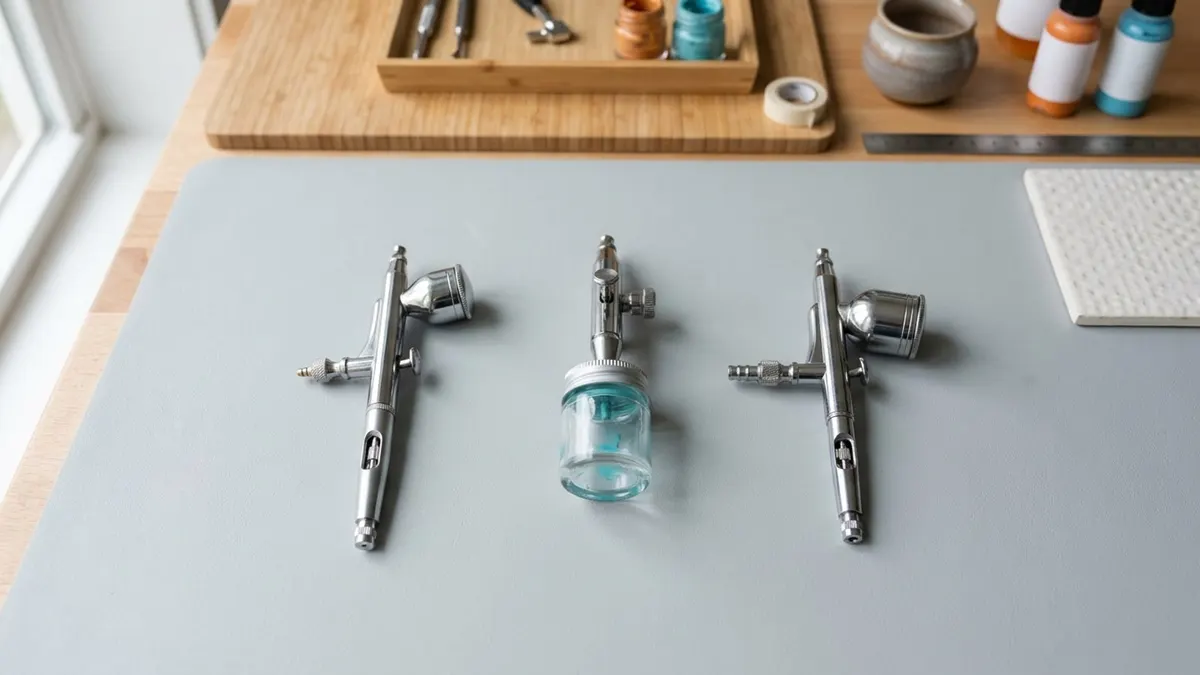
Feed: gravity, siphon or side
| Feed | Where the paint sits | Pressure | Best for |
|---|---|---|---|
| Gravity | A cup on top | Lowest: gravity helps the paint flow | Detail, small amounts, quick color changes |
| Siphon (bottom or bottle feed) | A jar or bottle underneath | Higher: the air has to lift the paint | Large areas, fabric, long runs of one color |
| Side | A cup or bottle on either side | In between | Clear sight line over the airbrush; left or right-handed setups |
Iwata's basics page gives the reasoning: gravity feed sprays at lower pressure and uses little paint, while siphon feed needs more pressure because the compressor does all the work, and suits larger amounts. Iwata's own figures show it. The gravity-feed Eclipse HP-CS has an optimal working pressure of 25 to 35 psi; the siphon-feed Eclipse HP-BCS, otherwise the same family, is rated 35 to 55 psi and takes a 2 oz (60 ml) bottle.
Harder & Steenbeck makes suction (siphon) versions of its main models (the Evolution X and Ultra X), and Paasche's VL is a siphon airbrush that takes bottles from 1/4 oz to 8 oz.
Mix: internal or external
In an internal-mix airbrush, air and paint meet inside the head and leave as a fine mist. In an external-mix airbrush, they leave through separate openings and mix in the air. Iwata says external mix is sometimes easier to clean but gives coarser atomization and less even patterns; all Iwata airbrushes are internal mix. Paasche's H is the classic external-mix model: simple, cheap and easy to clean, and Paasche rates it from 1/16 inch lines to 1-1/2 inch patterns.
Nozzle size
The nozzle (and its matching needle) sets the finest line and the thickest paint an airbrush will pass. Makers sell the same body with different heads:
| Nozzle | Typical use | Examples |
|---|---|---|
| 0.15 to 0.25 mm | Fine detail, freehand, faces on miniatures | H&S Infinity 2024 (0.25 mm titanium), Gaahleri Mobius 0.2 mm |
| 0.3 to 0.38 mm | General hobby and craft spraying | Iwata Eclipse E3 (0.35 mm per Iwata's nozzle listing), Paasche Talon TG#2 (0.38 mm) |
| 0.4 to 0.5 mm | Primer, varnish, metallics, base coats | H&S Evolution and Ultra 2024 (0.45 mm), Master G233 (0.5 mm set) |
| 0.6 mm and up | Fabric paint, large areas, thick media | Paasche VL size 3 (0.75 mm), H&S Evolution X Two in One (0.6 mm set) |
Smaller nozzles need thinner paint and clog sooner; larger ones forgive thicker paint but cannot draw a hairline. Two-nozzle airbrushes such as the H&S Infinity 2in1 or the Gaahleri GHAD-39 let you cover both ends.
Nozzle fitting
- Screw-in (threaded): the most common. Tighten gently; over-tightening cracks the nozzle.
- Compression fit: Iwata's Eclipse nozzle is clamped by the head cap, with no threads. Iwata says it is easy to install and clean and handles thicker material without clogging.
- Self-centering drop-in: H&S and Gaahleri use nozzles that seat themselves when the head is assembled, and strip without tools.
Other features worth knowing
- Trigger-style airbrushes. Iwata's HP-TH and NEO TRN1 use a pistol-style trigger instead of a top lever. Iwata says they suit painters used to spray guns and people with arthritis; they are still dual action.
- Micro air control (MAC) valve. A small valve on the airbrush itself that fine-tunes airflow for fine to medium spray and stipple effects. Iwata fits one to all its Hi-Line models.
- Cutaway handle. An open back that exposes the needle chucking nut so you can pull the needle back to flush the airbrush without removing the handle (Iwata's Eclipse HP-CS has one).
- Preset handle. A dial at the back that limits how far the trigger travels, so you can repeat the same line width; Harder & Steenbeck's Infinity has a Quick Fix end piece with an engraved scale for the same job.
- Solvent-resistant seals. Needed for lacquers and urethanes: H&S fits PTFE seals and Paasche PTFE packing to their airbrushes.
Which type to buy
| You paint | Buy |
|---|---|
| Models, miniatures, illustration | Dual action, gravity feed, 0.2 to 0.35 mm |
| First airbrush, mixed hobbies | Dual action, gravity feed, 0.3 to 0.45 mm |
| T-shirts, fabric, large boards | Dual action, siphon feed, 0.5 mm and up |
| Cakes, cookies, even single-color coats | Single or dual action, gravity feed |
| Simple coverage on a budget | Single action, external mix |
Ready to choose a model? See the best airbrush kits, the best airbrush for beginners and airbrushes for t-shirts.
Frequently asked questions
What is the difference between single action and dual action airbrushes?
On a dual-action airbrush the trigger controls both air (press down) and paint (pull back), so you can vary the line as you spray. On a single-action airbrush the trigger gives air only and a dial sets a fixed paint flow.
Is gravity feed or siphon feed better?
Gravity feed is better for detail and small amounts, and sprays at lower pressure. Siphon feed is better for large areas and long runs of one color, but needs more air: Iwata rates its siphon Eclipse at 35 to 55 psi against 25 to 35 psi for the gravity model.
What does internal mix mean on an airbrush?
Air and paint mix inside the airbrush head before they leave the nozzle, which gives finer atomization and more even patterns. External-mix airbrushes mix outside the tip: easier to clean, but coarser spray.
What size airbrush nozzle do I need?
Use 0.15 to 0.25 mm for fine detail, 0.3 to 0.38 mm for general hobby work, 0.4 to 0.5 mm for primers and metallics, and 0.6 mm or larger for fabric paint and large areas.
What is a side feed airbrush?
The paint cup or bottle attaches to the side of the airbrush instead of on top or underneath. Iwata says some users find it gives better visibility when painting details; it also lets you swap the cup to suit the hand you paint with.
Sources
- Airbrush Basics, Iwata-Medea
- Iwata Eclipse HP-CS (ECL4500), Iwata-Medea
- Iwata Eclipse HP-BCS (ECL2000), Iwata-Medea
- Evolution ALplus Airbrush (Evolution series), Harder & Steenbeck
- INFINITY 2024 CRplus, Harder & Steenbeck
- VL Model, Paasche Airbrush
- H Model, Paasche Airbrush
- Airbrushes (Iwata lineup and prices), Iwata-Medea
Cover image: Illustration: Airbrush Review (AI-generated)
Related guides
Best Airbrush for Beginners (2026): Five Starter Airbrushes Compared
Five first airbrushes, from a $40 three-nozzle set to Harder & Steenbeck's own beginner model, with the compressor each one needs.
Best Airbrush for Miniatures (2026): Detail, Base Coat and Budget Picks
Five airbrushes for painting 28 mm figures and larger, from a 0.25 mm titanium detail airbrush to a two-nozzle budget set, with the paint and pressure to use.
Best Airbrush Kits of 2026: Airbrush and Compressor Sets Compared
Five airbrush and compressor sets for models, crafts, cakes and art, picked on the makers' specs and what each box actually contains.