
How to Clean an Airbrush: Color Changes, End of Day and Deep Cleaning
How to clean an airbrush, from the makers: flushing between colors, stripping the needle and nozzle at the end of a session, soaking limits and what never to do.
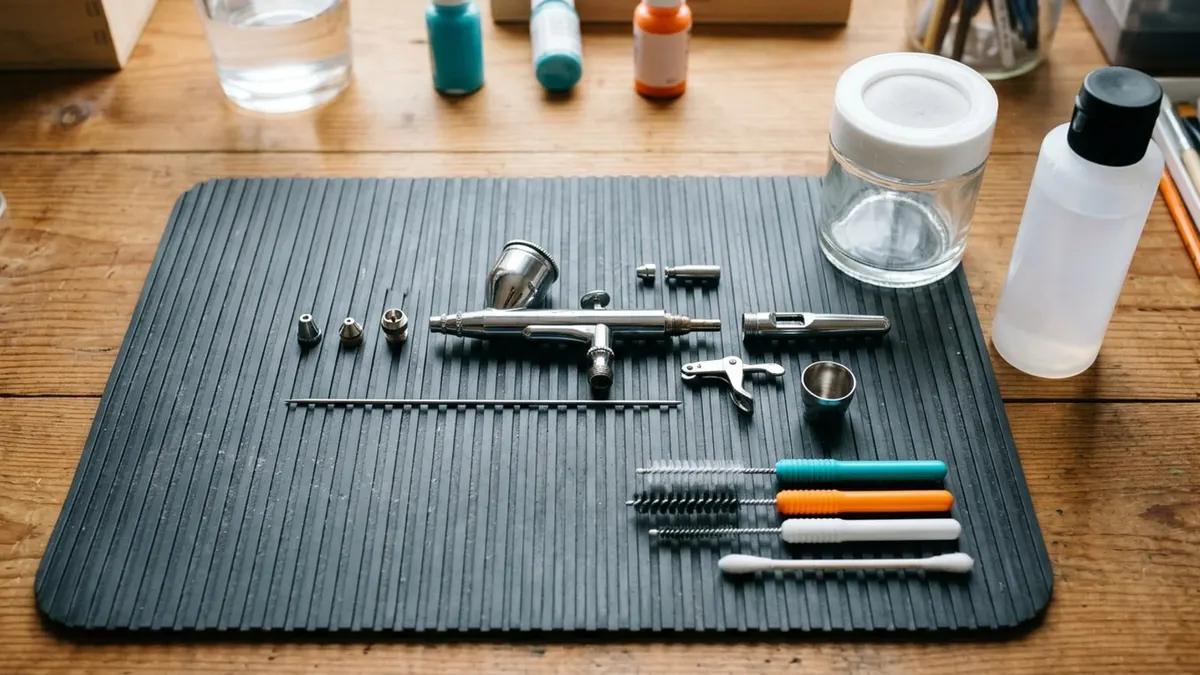
Affiliate disclosure: product links on this page go to Amazon, or to the maker's own store for brands that sell only direct. As an Amazon Associate we earn from qualifying purchases, at no extra cost to you; a link to a maker's store earns us nothing. No retailer or brand sees our picks before they are published or has any say in them. How we choose.
Clean an airbrush in three stages. Between colors, empty the cup, wipe it, and spray cleaner through until it runs clear into a cleaning pot. At the end of each session, take out the needle and nozzle, wipe the needle from back to front, soak the nozzle and caps briefly in cleaner, brush the paint passage, and reassemble. Every so often, inspect the nozzle and needle under magnification and replace damaged parts.
The two rules every maker agrees on: never soak the whole airbrush, and clean before paint dries. The steps below follow Iwata's own cleaning guide, with Createx's and Vallejo's instructions for their cleaners.
What you need
- Airbrush cleaner made for your paint (see airbrush cleaners).
- A cleaning pot to spray into, such as the Master 3-in-1 cleaning pot.
- Small cleaning brushes and pipe cleaners for the cup and paint passage.
- The wrench that came with your airbrush (Iwata's Eclipse uses its own head cap wrench).
- Paper towel or a lint-free cloth, and somewhere safe to put the needle.
1. Between colors (two minutes)
- Empty leftover paint from the cup.
- Brush the cup with a little cleaner and wipe it out; repeat until the cup is clean. Iwata uses its washing brush and Medea Airbrush Cleaner.
- Fill the cup with cleaner (or water, for water-based paint) and spray it through into the cleaning pot until it sprays clear.
- On a siphon airbrush, swap the paint bottle for a bottle of cleaner and spray through until clear.
Createx lists water, its 5618 Airbrush Cleaner or 4011 Reducer for rinsing colors out while you paint. Iwata suggests its Medea cleaner with a 360 degree nozzle for a quick flush.
2. End of session: needle and nozzle
- Disconnect the air. Remove the back handle and set it down safely.
- Remove the needle. Loosen the needle chucking nut by hand and slide the needle out. Wipe it with a little cleaner, only from back to front: Iwata says this keeps you from puncturing yourself, and it protects the tip.
- Remove the nozzle. Unscrew the needle cap and nozzle cap by hand. Threaded nozzles come out with the airbrush maker's nozzle wrench, turned to the left. Iwata's Eclipse is different: remove the head cap with its own wrench, never separate the nozzle from the head set, and never use the nozzle wrench on it.
3. Soak and scrub the small parts
This is where makers differ, so follow your cleaner's maker:
| Maker | What to soak | How long |
|---|---|---|
| Iwata (Medea Airbrush Cleaner) | Nozzle, needle cap, nozzle cap (and Eclipse head cap) | No more than 10 minutes |
| Vallejo Airbrush Cleaner 71.099 | Valve and nozzle, not the whole airbrush | Several hours, for thorough cleaning |
| Createx 4008 Restorer | Metal parts: nozzle, needle cap, needle, cup | At least 10 minutes; overnight is fine |
After soaking, scrub the parts with a small brush dipped in cleaner. Createx says cured paint then brushes off with soap and warm water, and to flush thoroughly with water afterward because even traces of 4008 affect paint. Createx also warns that 4008 dissolves soft plastics, so keep it away from stencils and from O-rings that are not PTFE.
4. Clean the paint passage and body
Dip a small brush or pipe cleaner in cleaner. On a gravity airbrush, push it down the cup's paint passage toward the front; on a bottom-feed airbrush, push it up through the bottle joint. Scrub back and forth, twisting, then clean from the front, until no paint comes out. Wipe the outside with a little cleaner.
5. Inspect
Iwata recommends checking under a magnifier for a cracked, dented or distorted nozzle, a bent needle and paint left in the passages. Damaged parts are replaced, not repaired; Iwata suggests keeping a spare needle and nozzle if you airbrush often.
6. Reassemble and lubricate
- Threaded nozzle: a light dab of thread sealer on the threads only (Iwata uses Medea Thread Sealer), then screw it in with the wrench until snug, not tight.
- Eclipse: seat the nozzle in the head base, screw on the head cap and tighten gently with its wrench.
- Fit the nozzle cap and needle cap finger tight.
- With the trigger held down, slide the needle in gently until it stops, tighten the chucking nut by hand, and refit the handle.
- Lubricate only when needed: Iwata suggests one drop of its lube at the base of the main lever if it is slow to rise, or one drop where the needle taper begins if the lever is stiff.
7. Test with water
Put water in the cup and press the trigger down only. Air alone should come out; if water sprays, the needle is not fully seated. Pull back and water should spray. If not, check the assembly and clean again.
Never do this
- Never soak or immerse the whole airbrush, or leave it standing in cleaner ("wet docking"). Iwata and Vallejo both say so.
- Never store paint or cleaner in the cup.
- Never force the needle in. Iwata says to reinsert it gently, with the trigger held down, until it stops.
- Never spray Createx 4008 through the airbrush; it is a soak, per its data sheet.
- Never over-tighten the nozzle. Iwata warns about the small spanner that comes with some airbrushes.
When cleaning does not fix it
Bubbles in the cup point to a loose nozzle cap or a cracked nozzle; spatter after cleaning often means paint still on the needle tip or in the needle cap. Iwata's troubleshooting steps are summarized in how to use an airbrush. Thinning paint correctly reduces how often you need a deep clean: see the thinning chart.
Frequently asked questions
How do you clean an airbrush between colors?
Empty the cup, brush and wipe it with a little cleaner, then fill it with cleaner or water and spray through into a cleaning pot until it sprays clear. On a siphon airbrush, spray cleaner from a clean bottle.
Can I soak my whole airbrush in cleaner?
No. Iwata says never to soak or immerse the whole airbrush, and Vallejo says to soak the valve and nozzle, not the whole airbrush. Soak only the small parts each cleaner's maker names.
How long should I soak an airbrush nozzle?
It depends on the cleaner's maker. Iwata says no more than 10 minutes in Medea Airbrush Cleaner. Vallejo allows several hours in its Airbrush Cleaner, and Createx says parts can soak in 4008 Restorer overnight.
What can I use to clean an airbrush?
Water flushes water-based paint between colors. For a proper clean use the paint maker's cleaner: Medea Airbrush Cleaner, Vallejo Airbrush Cleaner, or Createx 5618 to rinse and 4008 Restorer to soak off cured paint.
How often should I deep clean my airbrush?
Strip and clean the needle and nozzle at the end of every session, as Iwata's guide describes. A full strip-down with soaking and inspection is needed whenever spatter, bubbles or a stiff trigger appear.
Can I clean an airbrush in an ultrasonic cleaner?
Iwata's cleaning guide does not mention ultrasonic cleaners and says never to immerse the whole airbrush. If you use one, put in only metal parts the maker says may be soaked, and keep seals and O-rings out.
Sources
- Airbrush Cleaning, Iwata-Medea
- Troubleshooting, Iwata-Medea
- Airbrush Cleaner 71.099, Acrylicos Vallejo
- 4008 Restorer Technical Data Sheet, Createx Colors
- Textile, Leather & Flexible Substrates Guide (2023), Createx Colors
- High Flow Acrylic Colors, Golden Artist Colors
Cover image: Illustration: Airbrush Review (AI-generated)
Related guides
Airbrush Paint Thinning Chart: Ratios From Vallejo, Createx, Golden and Tamiya
Which paints spray from the bottle, which need thinning, with what, and how much, from the paint makers' own data sheets, with a drops calculator.
Airbrush Thinner Guide: Which Thinner for Which Paint, and How Much
Thinner, reducer, flow improver or water: what each does, which paint it belongs with, and the ratios the paint makers publish.
Best Airbrush Cleaner (2026): Medea, Vallejo, Createx and Master Compared
Rinse cleaners for color changes, soaking cleaners for cured paint, and the cleaning pot that keeps the mist out of the room.