
Airbrush Thinner Guide: Which Thinner for Which Paint, and How Much
Airbrush thinner explained: Vallejo Airbrush Thinner and Flow Improver, Createx 4011 Reducer, Tamiya X-20A and water, with each maker's ratio and what each does.
Affiliate disclosure: product links on this page go to Amazon, or to the maker's own store for brands that sell only direct. As an Amazon Associate we earn from qualifying purchases, at no extra cost to you; a link to a maker's store earns us nothing. No retailer or brand sees our picks before they are published or has any say in them. How we choose.
Use the thinner the paint maker makes for its paint: Vallejo Airbrush Thinner (71.261) for Vallejo paints, Createx 4011 Reducer for Createx and Wicked, Tamiya X-20A for Tamiya acrylics, and a little water for Golden High Flow. Each one is formulated to lower viscosity without breaking the paint's binder; Vallejo says its thinner dilutes color without loss of adhesion, resistance and consistency.
The ratios differ: Vallejo's is 3 parts paint to 1 part thinner (at most 25% thinner for airbrush colors), Createx's is 5 to 10% per volume (up to 20%), and Golden allows up to 20% water. Below: what thinners, reducers and flow improvers do, and which to buy.
Thinner, reducer, flow improver, retarder: what's the difference?
| Product type | What it does | Example |
|---|---|---|
| Thinner (reducer) | Lowers viscosity so the paint atomizes | Vallejo Airbrush Thinner 71.261; Createx 4011 Reducer; Tamiya X-20A |
| Flow improver | Slows drying in the airbrush, which cuts tip dry | Vallejo Airbrush Flow Improver 71.262 |
| Extender or transparent base | Makes color more transparent without thinning it | Golden Airbrush Transparent Extender; Createx 5601 Transparent Base |
| Mixing clear | Adds resin for adhesion and toughness, often then thinned | Createx 4030 Balancing Clear; Createx 4050 UVLS Gloss Clear |
Createx's 4011 data sheet is a good illustration of why a thinner is not just water: it lowers viscosity for better atomization and flow, reduces tip dry and improves drying and curing. It contains no resin, so Createx warns against over-reducing and says to extend colors with a resin-based clear instead.
The thinners, maker by maker
Vallejo Airbrush Thinner 71.261 and Flow Improver 71.262
Vallejo's thinner page gives two limits: airbrush colors take a maximum of 25% thinner, brush-on colors a maximum of 50%. Its Model Air chart recommends 1 part thinner to 3 parts paint, mixed in the airbrush cup, with the compressor at 1 to 1.5 kg or 15 psi. Flow Improver slows drying when airbrushing; Vallejo recommends 3 drops of paint to 1 of Flow Improver at the same pressure. Both come in several sizes (the thinner in 18, 32, 60 and 200 ml).
Createx 4011 Reducer
4011 is Createx's standard thinner for all its paints and clears. The data sheet says to add it generally at 5 to 10% per volume, in 5% steps, adding more only when needed for flow and fine atomization, and up to 20% for low-pressure work with small tips (it names Iwata's 0.18 mm Micron). Let the mix stand 10 minutes or more before spraying. Createx's application guides give higher figures for mixes that include its clears: about 20% for airbrush on its own, about 30% when 4050 clear is in the mix. The data sheet says it supersedes inconsistent information, including the label. Thinned paint is best used within 48 hours, because the reducer speeds evaporation of water from the paint.
Tamiya X-20A
Tamiya's page says X-20A is for diluting or cleaning away Tamiya Color Acrylic paints. It gives no ratio. Thin in small steps and test on scrap until the spray is smooth.
Water, for Golden High Flow
Golden says High Flow Acrylics spray from the container; for small adjustments add water, but over 20% water begins to change other properties. To make High Flow more transparent, Golden recommends Airbrush Transparent Extender, which does not thin the paint.
Ratios at a glance
| Paint | Thinner | Maker's ratio | Maker's pressure |
|---|---|---|---|
| Vallejo Model Air | Airbrush Thinner 71.261 | 3 paint : 1 thinner (max 25%) | About 15 psi |
| Vallejo brush colors | Airbrush Thinner 71.261 | Max 50% thinner | Not given |
| Createx Airbrush Colors, Wicked | 4011 Reducer | 5 to 10% per volume (up to 20%) | 60+ psi unthinned on shirts |
| Golden High Flow | Water | Up to 20% | 25 to 50 psi |
| Tamiya acrylic | X-20A | Not given | Not given |
Our thinning calculator turns these into drops for the amount in your cup.
How to thin in the cup, step by step
- Shake the paint well. Pigment settles in dropper bottles.
- Put the paint in first. Count drops into the airbrush cup; Vallejo's chart says to mix its thinner in the airbrush cup.
- Add thinner in small steps. Createx says to add 4011 in increments of about 5% and only add more when you need better flow and atomization.
- Stir, then wait if the maker says to. Createx asks for 10 minutes or more after adding 4011 so it acclimates with the paint.
- Test on scrap at your working pressure. Spatter or a grainy spray means too thick; runs and spidering mean too thin or too close.
Mixing ahead and storage
Createx says its paints have no true pot life and stay sprayable for about 48 hours once reduced, but that 4011 speeds the loss of water, so only thin what you will use within 48 hours, keep bottles capped airtight, and avoid adding reducer to paint you mean to store. For automotive spraying, its hard-surface guide also strains paint before use (190 micron mesh for its paints).
Can you mix brands?
Makers write their instructions for their own products, and none of the ones we read endorses another brand's thinner. Water-based thinners are not all the same formula (Createx's data sheet lists propylene glycol monomethyl ether acetate, for example), so if you do cross brands, test the mix on scrap before a project. Never put a lacquer or enamel thinner into a water-based acrylic.
Thinner as a cleaner
Some thinners double as a flush between colors: Createx lists 4011 alongside water and its 5618 Airbrush Cleaner for rinsing colors out while you paint, and Tamiya says X-20A cleans away its acrylics. For end-of-session cleaning, use a dedicated cleaner; see airbrush cleaners and how to clean an airbrush.
Frequently asked questions
What is the best airbrush thinner?
The one made by your paint's maker: Vallejo Airbrush Thinner for Vallejo paints, Createx 4011 Reducer for Createx and Wicked, Tamiya X-20A for Tamiya acrylics. Golden High Flow takes a little water instead.
What is the ratio of thinner to airbrush paint?
It depends on the paint. Vallejo gives 3 parts paint to 1 part thinner for Model Air, Createx gives 5 to 10% of 4011 per volume (up to 20%), and Golden allows up to 20% water in High Flow.
What does airbrush flow improver do?
It slows the paint's drying in the airbrush, which reduces dried paint on the needle tip. Vallejo recommends 3 drops of paint to 1 drop of its Flow Improver 71.262, at about 15 psi.
Can I use water instead of airbrush thinner?
For Golden High Flow, yes, up to 20%. For most other airbrush paints use the maker's thinner, which thins without weakening adhesion. Vallejo says its Airbrush Thinner dilutes color without loss of adhesion, resistance and consistency.
Can I use Vallejo thinner with Createx or Tamiya paint?
None of these makers endorses another brand's thinner. If you mix brands, test on scrap first. Never mix a lacquer or enamel thinner into water-based paint.
Sources
- Airbrush Thinner 71.261, Acrylicos Vallejo
- Vallejo Model Air color chart (2026), Acrylicos Vallejo
- 4011 Reducer Technical Data Sheet, Createx Colors
- Hard Surface & Automotive Guide (2023), Createx Colors
- Textile, Leather & Flexible Substrates Guide (2023), Createx Colors
- X-20A Acrylic Thinner, Tamiya
- High Flow Acrylic Colors, Golden Artist Colors
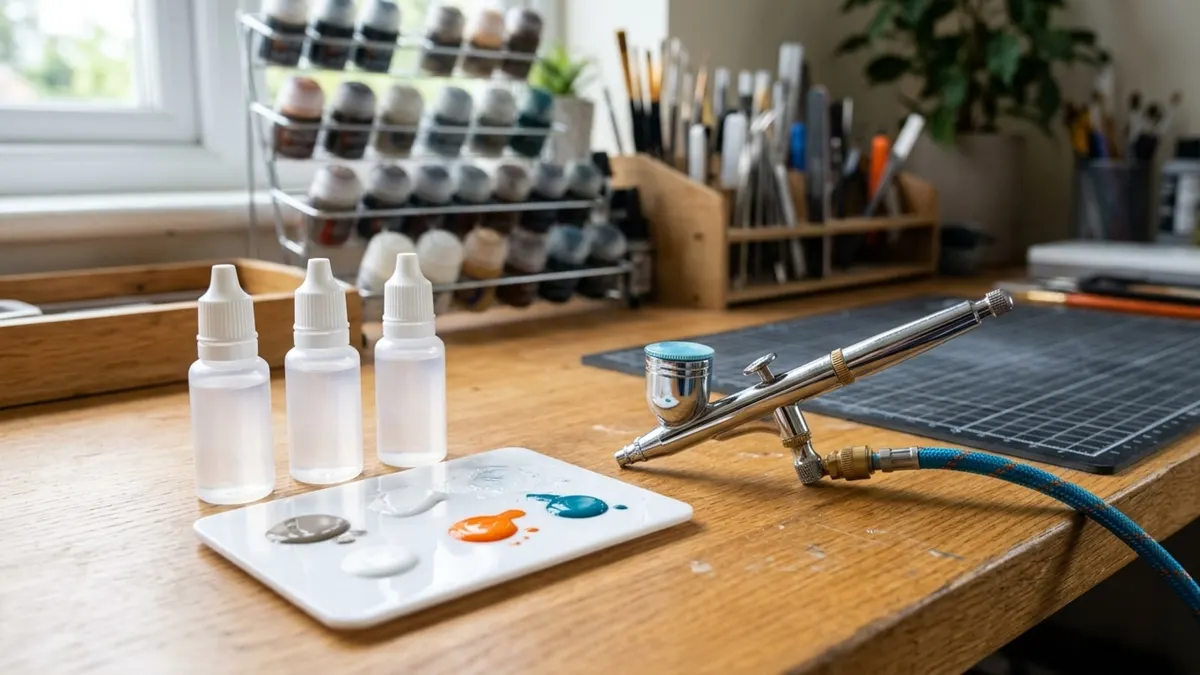
Cover image: Illustration: Airbrush Review (AI-generated)
Related guides
Airbrush Paint Thinning Chart: Ratios From Vallejo, Createx, Golden and Tamiya
Which paints spray from the bottle, which need thinning, with what, and how much, from the paint makers' own data sheets, with a drops calculator.
Best Airbrush Cleaner (2026): Medea, Vallejo, Createx and Master Compared
Rinse cleaners for color changes, soaking cleaners for cured paint, and the cleaning pot that keeps the mist out of the room.
Best Airbrush Paint of 2026: Vallejo, Createx, Golden and More Compared
Five airbrush paints for different jobs, chosen on what each maker says it is for, how far to thin it and what pressure it sprays at.