
Best Airbrush Spray Booth (2026): Hobby Booths Compared on Airflow
The best airbrush spray booths for models, miniatures and crafts, compared on rated airflow in CFM, filters, exhaust hose, lighting and work area.
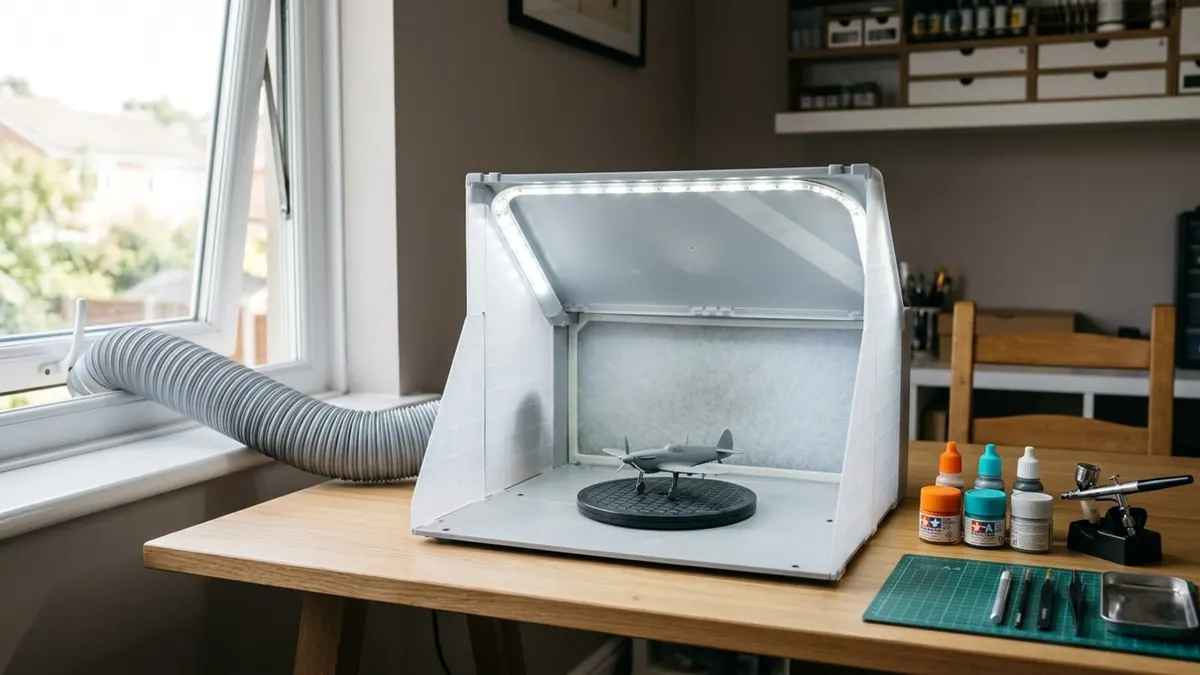
Affiliate disclosure: product links on this page go to Amazon, or to the maker's own store for brands that sell only direct. As an Amazon Associate we earn from qualifying purchases, at no extra cost to you; a link to a maker's store earns us nothing. No retailer or brand sees our picks before they are published or has any say in them. How we choose.
The best hobby spray booth for most airbrushers is the VEVOR AH-311: two fans rated at 9.2 cubic meters a minute (about 325 CFM), the most airflow of the booths we checked, with a 5 ft exhaust hose, LED lights and a turntable, sold by Amazon itself. The T TOGUSH dual-fan booth is close behind at 9 m³/min with separate fan and light controls. For a small desk, Master Airbrush's B3000 is compact and has a narrow hose end that fits a window gap.
Airflow is the number that matters, and it is the one most listings give in cubic meters per minute. We converted each to CFM and worked out how big an opening each fan could pull air across at the face velocity OSHA uses for small workplace booths. Below: the picks, that arithmetic and how to vent a booth.
Our top picks at a glance
1. Best overall
VEVOR AH-311 dual-fan airbrush spray boothRated airflow: 9.2 m³/min (about 325 CFM) (per the Amazon listing) · Fans: Two · Exhaust hose: 5 ft · Work area: 21.5 x 18.7 x 14.6 in
2. Best for control
T TOGUSH dual 34 W spray boothRated airflow: 9 m³/min (about 318 CFM) (per the Amazon listing) · Fans: Two 34 W · Exhaust hose: Extends to 67 in · Work area: 20 x 13 x 11.5 in
3. Best compact booth
Master Airbrush B3000 dual-fan spray boothRated airflow: 5.2 m³/min (about 184 CFM) (per the Amazon listing) · Fans: Two · Exhaust hose: 16 in to 6 ft, narrow end piece · Work area: 16 x 18 x 13 in
4. Best large work area
Master Airbrush B550LK large spray boothRated airflow: 4 m³/min (about 141 CFM) (per the Amazon listing) · Fans: One 25 W, 12 V DC · Exhaust hose: 6 ft · Work area: 22.25 x 19 x 14 in
| Pick | Rated airflow | Fans | Exhaust hose | Work area | Buy |
|---|---|---|---|---|---|
| VEVOR AH-311 dual-fan airbrush spray boothBest overall | 9.2 m³/min (about 325 CFM) (per the Amazon listing) | Two | 5 ft | 21.5 x 18.7 x 14.6 in | Amazon |
| T TOGUSH dual 34 W spray boothBest for control | 9 m³/min (about 318 CFM) (per the Amazon listing) | Two 34 W | Extends to 67 in | 20 x 13 x 11.5 in | Amazon |
| Master Airbrush B3000 dual-fan spray boothBest compact booth | 5.2 m³/min (about 184 CFM) (per the Amazon listing) | Two | 16 in to 6 ft, narrow end piece | 16 x 18 x 13 in | Amazon |
| Master Airbrush B550LK large spray boothBest large work area | 4 m³/min (about 141 CFM) (per the Amazon listing) | One 25 W, 12 V DC | 6 ft | 22.25 x 19 x 14 in | Amazon |
Best overall
VEVOR AH-311 dual-fan airbrush spray booth
The most rated airflow of the booths we checked, in a folding case, from a listing sold by Amazon.
- Rated airflow
- 9.2 m³/min (about 325 CFM) (per the Amazon listing)
- Fans
- Two
- Exhaust hose
- 5 ft
- Work area
- 21.5 x 18.7 x 14.6 in
Pros
- Highest rated airflow here
- Replacement filter cotton included, three LED lights, detachable turntable (per the Amazon listing)
- Folds into a case
Cons
- Airflow is a free-air rating; filters and hose reduce it
- No published noise figure
VEVOR rates the AH-311's two fans at 9.2 cubic meters a minute, which is about 325 cubic feet a minute (CFM). That is the most of the hobby booths we compared, and it means the fans can, on paper, pull air across a larger opening at a useful speed (see the table below). The listing includes thick filter cotton with replacements, three LED lights, a detachable turntable and a 5 ft exhaust hose; it folds into a carrying case.
As with every hobby booth, the airflow figure is the fan's free-air rating. Filters, the hose and any bends all cut it, so keep the hose short and straight and change filters when they clog.
Best for control
T TOGUSH dual 34 W spray booth
Nearly as much airflow, with separate knobs for fan speed and lights and a rated 53 dB.
- Rated airflow
- 9 m³/min (about 318 CFM) (per the Amazon listing)
- Fans
- Two 34 W
- Exhaust hose
- Extends to 67 in
- Work area
- 20 x 13 x 11.5 in
Pros
- Adjustable fan speed and light brightness
- Two-layer filter cotton
- Rated as low as 53 dB (per the Amazon listing)
Cons
- Smaller work area than the VEVOR
- Measurement conditions for noise not stated
T TOGUSH rates its two 34 W fans at 9 cubic meters a minute (about 318 CFM), with a two-layer filter, an exhaust hose that extends to 67 inches, three LED lights and two knobs that set fan speed and brightness separately (per the listing). The work area is 20 by 13 by 11.5 inches, smaller than the VEVOR's. The fan-speed knob is useful: run it high while spraying and low while the paint flashes off.
Best compact booth
Master Airbrush B3000 dual-fan spray booth
A small dual-fan booth with a hose end shaped for a window or door gap.
- Rated airflow
- 5.2 m³/min (about 184 CFM) (per the Amazon listing)
- Fans
- Two
- Exhaust hose
- 16 in to 6 ft, narrow end piece
- Work area
- 16 x 18 x 13 in
Pros
- Narrow hose end for window or door gaps (per the Amazon listing)
- High-density fiberglass filter
- Four LED lights and a 7.5 in turntable
Cons
- Less airflow than the larger booths
- Best for small parts and figures
Master Airbrush's B3000 has two exhaust fans rated at 5.2 cubic meters a minute (about 184 CFM), a high-density fiberglass filter, four LED lights, a 7.5 inch turntable and an exhaust hose that extends from 16 inches to 6 feet with a narrow end piece for a window or door gap (per the listing). It suits miniatures, small models and cookies on a desk where a larger booth will not fit.
Best large work area
Master Airbrush B550LK large spray booth
A wide, deep booth for larger models, with one fan; Master says booths can be combined for more width.
- Rated airflow
- 4 m³/min (about 141 CFM) (per the Amazon listing)
- Fans
- One 25 W, 12 V DC
- Exhaust hose
- 6 ft
- Work area
- 22.25 x 19 x 14 in
Pros
- Large work area
- Two-layer fiberglass filter
- Folds into a suitcase shape, 8.5 lb (per the Amazon listing)
Cons
- Lowest airflow per square inch of opening here
- Single fan
The B550LK gives a 22.25 by 19 by 14 inch work area with LED lighting, a 7.5 inch turntable and a two-layer fiberglass filter, and a single 25 W fan rated at 4 cubic meters a minute (about 141 CFM) (per the listing). That is a lot of opening for one fan. It suits occasional large models and props sprayed with water-based paint; for regular use, the dual-fan booths above move more air.
Airflow, converted and checked
OSHA's spray finishing rule (29 CFR 1910.94, Table G-10) sets minimum air velocities into workplace spray booths. For a small booth used with hand-held air-operated spray guns and crossdrafts up to 50 feet per minute, it gives a design velocity of 150 fpm (range 125 to 175), and OSHA's companion rule, 1910.107, asks for an average of at least 100 fpm over a booth's open face. That rule is written for workplaces, not hobby rooms, but it is a useful yardstick: divide a fan's CFM by 150 and you get the largest opening, in square feet, it could pull air across at that speed.
| Booth | Rated airflow | In CFM | Opening at 150 fpm (free-air rating) |
|---|---|---|---|
| VEVOR AH-311 | 9.2 m³/min | 325 | 2.2 sq ft (about 312 sq in) |
| T TOGUSH dual 34 W | 9 m³/min | 318 | 2.1 sq ft (about 305 sq in) |
| Master B3000 | 5.2 m³/min | 184 | 1.2 sq ft (about 176 sq in) |
| Master B550LK | 4 m³/min | 141 | 0.9 sq ft (about 136 sq in) |
1 cubic meter is 35.31 cubic feet. Compare the last column with your booth's front opening (width times height). The figures are optimistic, because fans are rated with no filter or hose attached. A booth whose opening is much bigger than that figure will still catch overspray near the back, but it will not pull mist away from the front edge where you stand. Our ventilation guide covers the arithmetic, make-up air and hose runs.
What to look for
- Airflow in a real unit. m³/min or CFM. Ignore fan wattage on its own.
- An exhaust hose. A booth that only filters and blows the air back into the room traps particles but not solvent vapor. Vent outside.
- Replaceable filters. OSHA's rule says to replace or clean booth filters when the pressure drop across them becomes excessive; in practice, when they look loaded or airflow falls.
- Work area and lighting. Bigger is not better if the fan cannot keep up.
Lighting, turntables and size
Every booth here has LED lighting and a turntable: three LEDs on the VEVOR and T TOGUSH, four on the Master B3000, and a 7.5 inch turntable on both Master booths (per the listings). Lighting matters more than it sounds in a booth, because the hood shades the work. Pick the smallest booth that fits your largest piece with a few inches to spare: a bigger opening needs more airflow to keep the same face velocity.
Setting one up
- Put the booth near a window and keep the hose as short and straight as you can.
- Seal the window gap around the hose end so exhaust does not blow back in.
- Open another window or door across the room for make-up air; OSHA's rule calls for fresh air equal to the volume exhausted in workplaces.
- Spray toward the back of the booth, a few inches inside the opening.
- Keep the respirator on: a booth reduces exposure but does not remove it. See respirators for airbrushing.
Water-based vs solvent-based paint
Hobby booths use small motors and are sold for water-based paint on models, crafts and cakes. Solvent paints create flammable vapor; OSHA's rule requires workplace booths to dilute solvent vapor to at least 25% of its lower explosive limit, and NFPA 33 covers spray booth fire safety. If you spray lacquers or enamels, read the paint's safety data sheet and the booth maker's instructions before using a hobby booth for them.
Painting cars or large parts? See inflatable paint booths.
Frequently asked questions
Do I need a spray booth for airbrushing?
It is strongly worth having indoors. Airbrushing puts fine paint mist in the room, and a booth with an exhaust hose pulls much of it outside. Wear a respirator suited to the paint as well; a booth reduces exposure but does not remove it.
How much CFM does an airbrush spray booth need?
Multiply the booth's front opening in square feet by a target face velocity. OSHA's workplace design figure for small booths with hand-held spray guns is 150 fpm, so a 2 sq ft opening needs about 300 CFM before filter losses.
Can I use a spray booth without venting it outside?
A filter catches paint particles but not solvent vapor or odor, so a booth that blows air back into the room only does half the job. Vent the hose out of a window, and open another window for fresh air.
How often should I change spray booth filters?
When they look loaded or the airflow drops. OSHA's rule for workplace booths says filters must be replaced or cleaned whenever the pressure drop across them becomes excessive. Keep spares on hand.
Can I use a hobby spray booth for solvent-based paint?
Check the booth maker's instructions and the paint's safety data sheet first. Solvent paints create flammable vapor, and workplace booths must dilute it to at least 25% of the lower explosive limit under OSHA's rule. Hobby booths are sold for water-based paint.
Sources
Cover image: Illustration: Airbrush Review (AI-generated)
Related guides
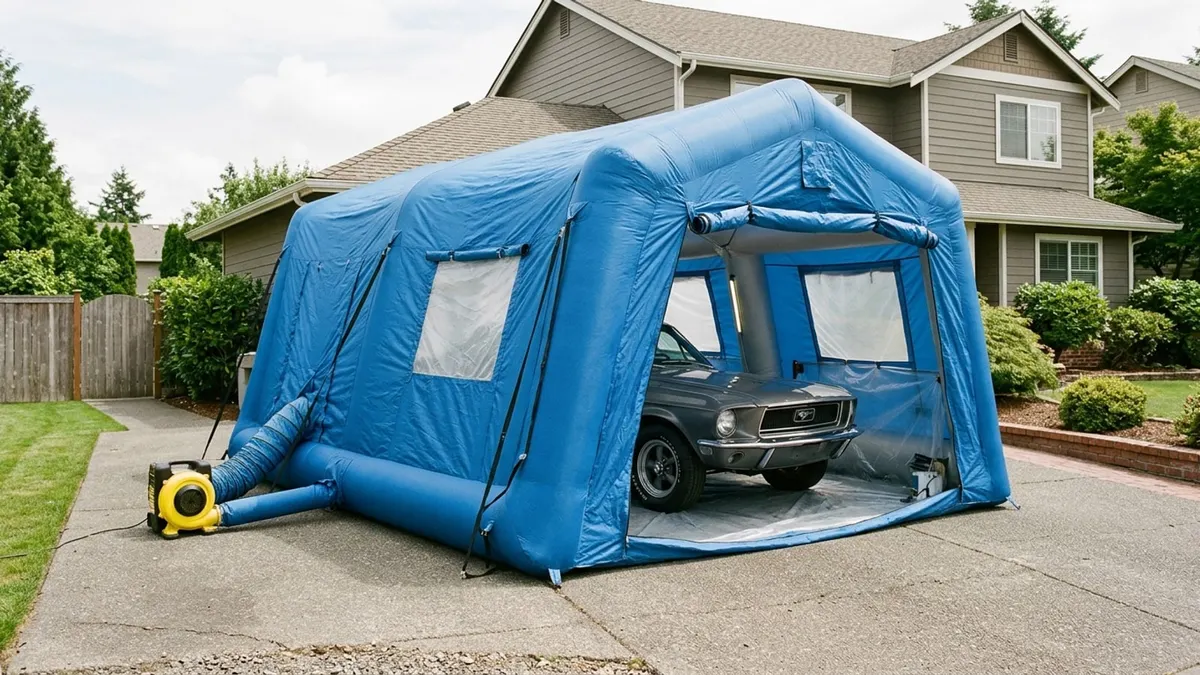
Best Inflatable Paint Booth (2026): Sizes, Blowers and the Rules That Apply
Three blow-up spray booths from motorcycle size to pickup size, what their blowers and filters do, and when the EPA's auto-refinishing rule reaches a home garage.
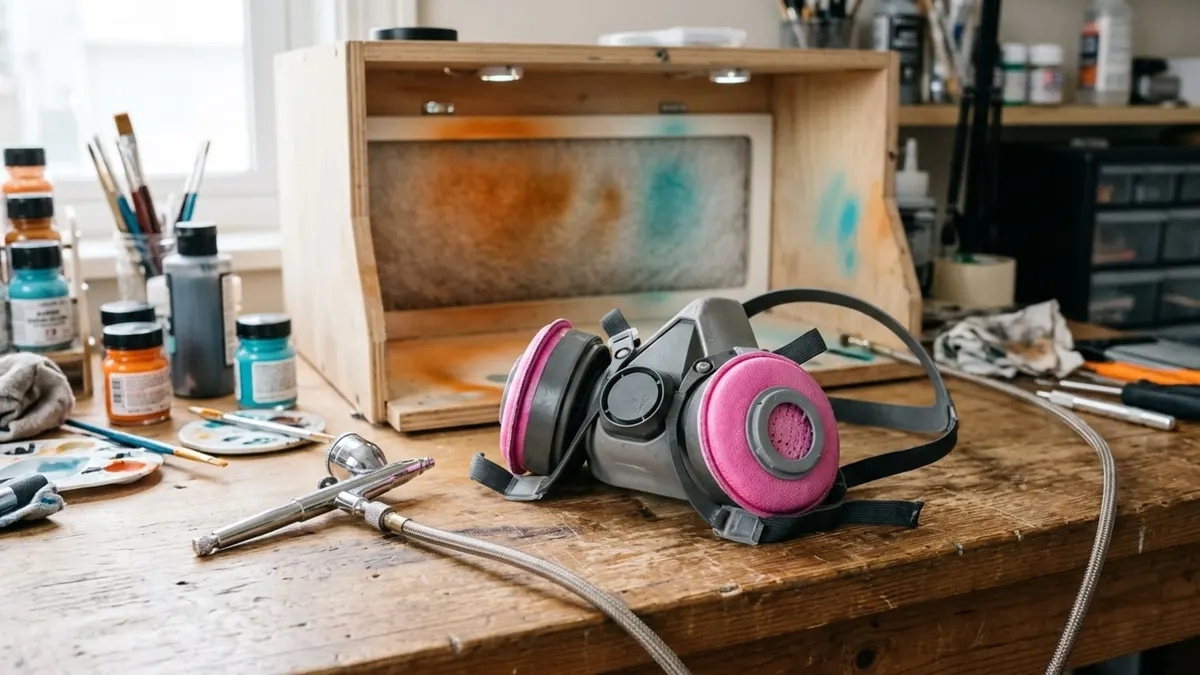
Best Respirator for Airbrushing (2026): Cartridges and Filters Explained
Why a dust mask is not enough for airbrushing, what N, R and P filters and organic vapor cartridges do, and the reusable half masks that cover both.
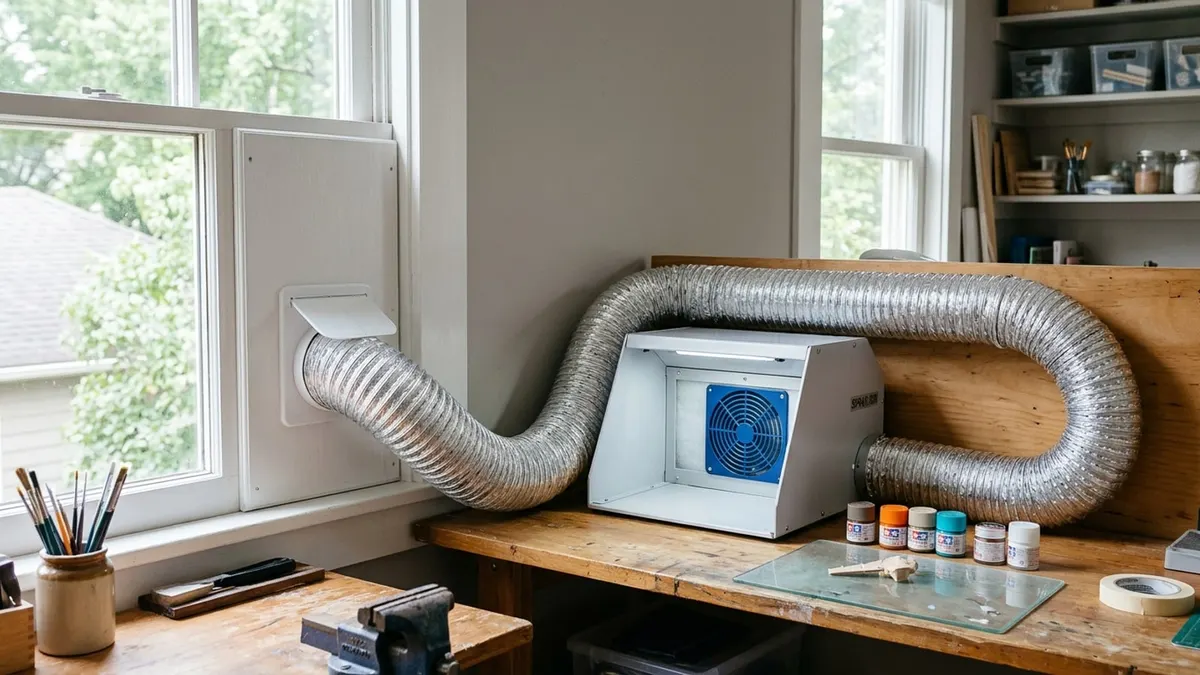
Spray Booth Ventilation: How Much Airflow You Need and How to Vent It
The arithmetic behind a working spray booth: opening size times face velocity, what filters and hoses take away, and how to get the air out of the room.