
Spray Booth Ventilation: How Much Airflow You Need and How to Vent It
Spray booth ventilation explained: the face velocity OSHA uses, how to turn it into CFM for your booth, venting through a window, make-up air and filters.
Affiliate disclosure: product links on this page go to Amazon, or to the maker's own store for brands that sell only direct. As an Amazon Associate we earn from qualifying purchases, at no extra cost to you; a link to a maker's store earns us nothing. No retailer or brand sees our picks before they are published or has any say in them. How we choose.
A spray booth works when it pulls air across its whole front opening fast enough to carry overspray away from you, and sends that air outside. OSHA's workplace spray-booth rule gives the speed to aim for: in a small booth with hand-held spray guns and little crossdraft, a design face velocity of 150 feet per minute (125 to 175 fpm), and its companion rule asks for at least 100 fpm on average. Multiply your booth's front opening in square feet by that speed and you get the airflow, in CFM, the fan has to deliver after filters and hose.
Then give the air a way out (a short, straight hose through a sealed window gap) and a way in (another open window or door). Here is the arithmetic, the setup and the filter care.
Step 1: work out the airflow you need
Required CFM = front opening (sq ft) x face velocity (fpm)
- Measure the booth's open front: width and height, in inches.
- Multiply them and divide by 144 to get square feet.
- Multiply by 150 fpm (OSHA's small-booth design figure for hand-held spray guns with crossdrafts up to 50 fpm), or by 100 fpm for the minimum average in OSHA's 1910.107.
| Front opening | Area | CFM at 100 fpm | CFM at 150 fpm |
|---|---|---|---|
| 16 x 12 in | 1.33 sq ft | 133 | 200 |
| 20 x 13 in | 1.81 sq ft | 181 | 271 |
| 22 x 15 in | 2.29 sq ft | 229 | 344 |
| 24 x 18 in | 3.00 sq ft | 300 | 450 |
Hobby booth listings usually give airflow in cubic meters a minute. One cubic meter is 35.31 cubic feet, so 5.2 m³/min is about 184 CFM and 9.2 m³/min about 325 CFM. Our spray booth roundup converts each booth's rating.
A worked example
Take a booth rated at 9.2 m³/min (about 325 CFM) with a front opening of 20 by 13 inches. The opening is 260 square inches, or 1.81 square feet. At OSHA's 150 fpm design figure it needs about 271 CFM; at the 100 fpm minimum, about 181 CFM. The fan's free-air rating of 325 CFM leaves some margin for the filter and a short hose, but not much for a long, bent duct. With a 24 by 18 inch opening (3 square feet), the same fan falls short of 150 fpm (450 CFM) even before losses.
Step 2: allow for losses
Fan ratings are free-air figures, measured with nothing in the way. A filter, a long hose, bends and a window insert all cut the real airflow, and the loss grows as filters load with paint. OSHA's rule for workplace booths says filters must be replaced or cleaned whenever the pressure drop across them becomes excessive, and serviced if face velocity falls below its table. In a hobby room that means: buy a booth with clear headroom over your required CFM, keep the hose short, and change filters before they look clogged.
Step 3: vent outside
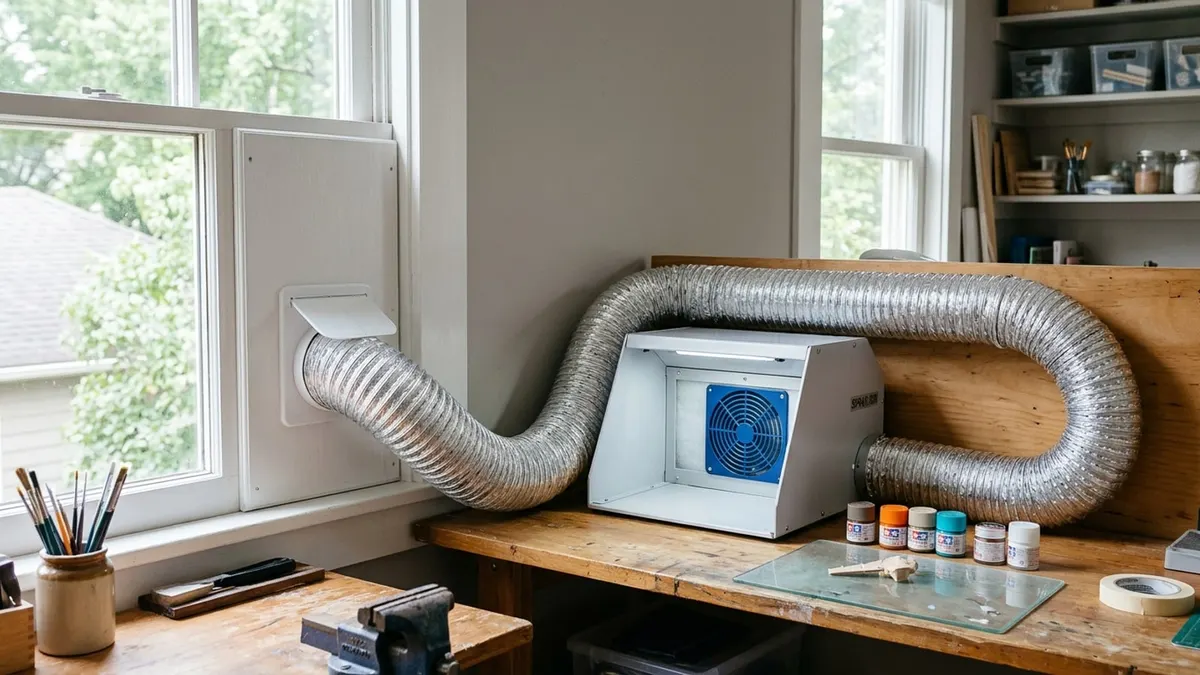
- Through a window. Run the hose to a window and seal the gap around it with a panel or insert, so exhaust does not blow back in. Master Airbrush's B3000 has a narrow hose end for a window or door gap (per its listing).
- Keep it short and straight. Every foot and every bend costs airflow.
- Point it away from intakes. Keep the outlet away from other windows, doors and air intakes.
- Recirculating booths (filter only, no hose) catch particles but return vapor and odor to the room. Treat them as particle catchers, not ventilation.
Step 4: let air in
A fan cannot pull air out of a closed room. OSHA's rule calls for clean make-up air equal to the volume exhausted in workplace booths. At home, open another window or door on the far side of the room. Keep crossdrafts down at the booth itself: OSHA's table drops its allowance as crossdrafts rise and says crossdrafts over 100 fpm should not be permitted, because a breeze across the opening pushes overspray back out.
Step 5: solvent paints need more care
OSHA's spray finishing rule (1910.107) is written for flammable and combustible finishing materials. It bars open flames and spark-producing equipment in a spraying area or within 20 feet of it, bars portable electric lamps in the spray area during spraying, and requires workplace exhaust to keep solvent vapor at or below 25% of its lower explosive limit (1910.94). Hobby booths are sold for water-based paint; if you spray lacquers, enamels or urethanes, read the paint's safety data sheet and the booth maker's manual first, and keep heaters, pilot lights and tools that spark away from the area. The same rule keeps electric motors that drive exhaust fans out of booths and ducts, and has freshly sprayed work dried only in ventilated spaces, so leave the booth fan running while the paint dries.
Step 6: filters and housekeeping
- Replace booth filters when they load up; keep spares.
- OSHA's rule has used filter pads moved to a safe, detached place, or kept in a water-filled metal container until disposal, because paint-soaked filters can be a fire risk.
- Put rags soaked with paint or thinner in a metal can; OSHA's rule calls for approved metal waste cans for them in workplaces, emptied at least once a day.
- Wipe overspray off the booth walls regularly; OSHA calls for spraying areas to be kept free of combustible residue.
Ventilation is not a respirator
Even a good booth leaves some mist around the opening where you work. Createx recommends a NIOSH or MSHA approved respirator any time you paint. NIOSH notes that filtering facepiece respirators do not protect against gases or vapors, so solvent paints need an organic vapor cartridge. See respirators for airbrushing, and for large jobs, inflatable paint booths.
Frequently asked questions
How much CFM do I need for a spray booth?
Multiply the front opening in square feet by the face velocity. OSHA's design figure for small workplace booths with hand-held spray guns is 150 fpm, so a 20 x 13 inch opening (1.81 sq ft) needs about 271 CFM, before filter and hose losses.
What face velocity should a spray booth have?
OSHA's Table G-10 gives 150 fpm (range 125 to 175) for small booths with air-operated spray guns and crossdrafts up to 50 fpm, and OSHA's 1910.107 asks for at least 100 fpm on average. These are workplace rules, useful as a target at home.
How do I vent a spray booth through a window?
Run the exhaust hose to the window by the shortest straight route and seal the gap around the hose end with a panel or insert. Open another window or door across the room so fresh air can replace what the booth removes.
Can I use a bathroom fan or box fan as a spray booth?
A box fan is not rated for paint overspray or solvent vapor, and its motor sits in the airstream. OSHA's workplace rule bars spark-producing equipment within 20 feet of solvent spraying. Use a booth sold for spraying, and water-based paint indoors.
Do spray booth filters stop fumes?
Booth filters catch paint particles. Vapor and odor pass through unless the booth has an activated carbon stage, and even then venting outside is what removes them. Wear a respirator with an organic vapor cartridge for solvent paints.
Sources
Cover image: Illustration: Airbrush Review (AI-generated)
Related guides
Best Airbrush Spray Booth (2026): Hobby Booths Compared on Airflow
Four portable hobby booths, with their airflow converted to CFM and checked against the face velocity OSHA sets for workplace spray booths.
Best Inflatable Paint Booth (2026): Sizes, Blowers and the Rules That Apply
Three blow-up spray booths from motorcycle size to pickup size, what their blowers and filters do, and when the EPA's auto-refinishing rule reaches a home garage.
Best Respirator for Airbrushing (2026): Cartridges and Filters Explained
Why a dust mask is not enough for airbrushing, what N, R and P filters and organic vapor cartridges do, and the reusable half masks that cover both.