
Airbrush PSI Chart: The Pressure Each Paint and Airbrush Maker Recommends
Airbrush PSI chart from the makers themselves: Vallejo, Golden, Createx, Iwata, Harder & Steenbeck and Paasche pressures, with a finder for your paint and airbrush.
Affiliate disclosure: product links on this page go to Amazon, or to the maker's own store for brands that sell only direct. As an Amazon Associate we earn from qualifying purchases, at no extra cost to you; a link to a maker's store earns us nothing. No retailer or brand sees our picks before they are published or has any say in them. How we choose.
The right airbrush pressure is the one the paint maker gives, inside the range your airbrush maker gives. Vallejo says 15 psi for Model Air and 15 to 20 psi for its Surface Primer; Golden gives 20 to 40 psi for illustration and 40 to 70 psi for t-shirts; Createx says its paints spray straight from the bottle at 60 psi and up on shirts through a 0.5 mm airbrush. On the airbrush side, Iwata rates the NEO CN at 8 to 20 psi and the Eclipse HP-CS at 25 to 35 psi.
Pick your paint and airbrush below to see where the two overlap. Every figure is from the maker's own page or data sheet, read in November 2026, and is listed with its source in the tables underneath.
Airbrush PSI finder
Start at
15 psi
Paint maker's figure
Paint maker says
15 psi
Vallejo Model Air color chart (2026)
Airbrush maker says
No figure
Not selected
- Paint: Vallejo: compressor at 1 to 1.5 kg, or 15 psi, when thinned with Airbrush Thinner or Flow Improver. Sold ready to airbrush. Source
Figures are the makers' own, read November 2026. Set the regulator with the trigger pressed (air flowing): the gauge reads higher with the airbrush closed. Thinner paint, finer lines and smaller nozzles usually want lower pressure; always test on scrap.
Paint makers' pressure guidance
| Paint | Maker's pressure | Notes |
|---|---|---|
| Vallejo Model Air | 15 psi (1 to 1.5 kg) | Sold ready to airbrush; the figure is given for paint thinned with Airbrush Thinner or Flow Improver |
| Vallejo Surface Primer | 15 to 20 psi | Vallejo also prints "0.5 to 1 kg"; use directly or diluted |
| Golden High Flow Acrylics | 25 to 50 psi (smaller airbrushes) | As low as 10 psi for a stipple, up to 60 psi for fine atomization |
| Golden, illustration on hot-press board | 20 to 40 psi | Airbrush Colors or Fluids with High Flow Medium |
| Golden, fine art on canvas or sign board | 25 to 50 psi | Airbrush Medium or High Flow Medium |
| Golden, automotive (helmets, tanks) | 25 to 50 psi | Airbrush Colors or Fluids |
| Golden, textiles (t-shirts, leather) | 40 to 70 psi | Fluids with Airbrush Medium |
| Createx Airbrush Colors or Wicked, t-shirts | 60+ psi | Straight from the bottle, large-volume 0.5 mm airbrush |
| Createx paints, hard surfaces | Not given | All Createx paints spray through a 0.5 mm airbrush; thin with 4011 until it atomizes |
| Tamiya acrylic (X, XF) | Not given | Tamiya's X-20A page gives no ratio or pressure |
Airbrush makers' working ranges
| Airbrush | Maker's range |
|---|---|
| Iwata NEO CN | 8 to 20 psi |
| Iwata Revolution HP-CR | 20 to 30 psi |
| Iwata Eclipse HP-CS | 25 to 35 psi |
| Iwata Eclipse HP-BCS (siphon) | 35 to 55 psi |
| Harder & Steenbeck Ultra 2024 | A compressor that runs it up to about 25 psi |
| Paasche Talon TG and VL | 20 to 75 psi (20 psi at 0.5 CFM) |
| Gaahleri Mobius 0.3 mm | About 10 psi minimum |
How to use these numbers
- Start from the paint maker. Paint makers formulate for a pressure; an airbrush range is a working window, not a target.
- Set the pressure with air flowing. On most compressors the gauge reads higher when the airbrush is closed and drops when you press the trigger. Gaahleri says so plainly about its tankless TurboX Mini. Hold the trigger down for air and then set the regulator.
- Go lower for detail. Iwata's setup guide says to turn the pressure down for finer lines. Lower pressure also means less overspray and less paint drying on the needle tip.
- Go higher for thick paint, primer and fabric. Golden's textile range (40 to 70 psi) and Createx's 60+ psi for t-shirts show how much more air unthinned paint into fabric takes.
- If the makers do not overlap, test. A paint that wants 15 psi in an airbrush rated 25 to 35 psi will usually still spray; thin it a little more and check the pattern on scrap.
What your compressor needs to manage
The compressor has to hold the working pressure while you spray, not just reach it. Small compressors cover low-pressure work: Iwata's Ninja Jet works at 1 to 15 psi. All-round airbrushes and primers need more headroom: Iwata's Smart Jet Pro works at 1 to 30 psi (50 psi maximum), and tank compressors such as the Master TC-326T shut off at 57 psi (per its listing). Fabric work at 40 psi and up needs a compressor rated well above that. Our compressor guide compares them, and using a shop compressor covers the regulator you need on a garage unit.
Pressure problems
| You see | Pressure may be | Also check |
|---|---|---|
| Spatter, grainy spray | Too low for the paint | Paint too thick, dried tip (Iwata) |
| Runs, spider legs, paint blown around | Too high for the distance | Too much paint, too close |
| Line breaks up at low pressure | Pulsing compressor | A tank or a better regulator |
| Overspray everywhere | Too high | Paint too thin |
Thinning and pressure work together; see the paint thinning chart and how to use an airbrush.
Frequently asked questions
What PSI should I airbrush at?
Use the paint maker's figure within your airbrush maker's range. Vallejo gives 15 psi for Model Air, Golden gives 20 to 40 psi for illustration, and Iwata rates its NEO CN at 8 to 20 psi and Eclipse HP-CS at 25 to 35 psi.
What PSI for airbrushing miniatures?
Vallejo, which makes Model Air for all types of models, gives 15 psi for Model Air and 15 to 20 psi for its Surface Primer. Fine detail often goes lower; set the pressure with the trigger pressed and test on scrap.
What PSI for airbrushing t-shirts?
Higher than for hobby work. Createx says its Airbrush Colors and Wicked Colors spray from the bottle at 60+ psi through a large-volume 0.5 mm airbrush, and Golden gives 40 to 70 psi for textiles.
Why does my airbrush pressure drop when I spray?
The gauge shows static pressure when the airbrush is closed. When air flows, pressure falls, most on tankless compressors. Set the regulator while pressing the trigger so the reading matches what you actually spray at.
Is higher airbrush pressure better?
No. Higher pressure atomizes thick paint better but makes more overspray and dries paint faster on the surface. Lower pressure gives finer lines and less overspray. Use the paint maker's figure and adjust in small steps.
Sources
- Vallejo Model Air color chart (2026), Acrylicos Vallejo
- Vallejo Primers, Acrylicos Vallejo
- Airbrush Tips, Vol. 2, Golden Artist Colors
- High Flow Acrylic Colors, Golden Artist Colors
- Textile, Leather & Flexible Substrates Guide (2023), Createx Colors
- Hard Surface & Automotive Guide (2023), Createx Colors
- Equipment Setup, Iwata-Medea
- Iwata Eclipse HP-CS (ECL4500), Iwata-Medea
- Ultra 2024, Harder & Steenbeck
- TG Model, Paasche Airbrush
Cover image: Illustration: Airbrush Review (AI-generated)
Related guides
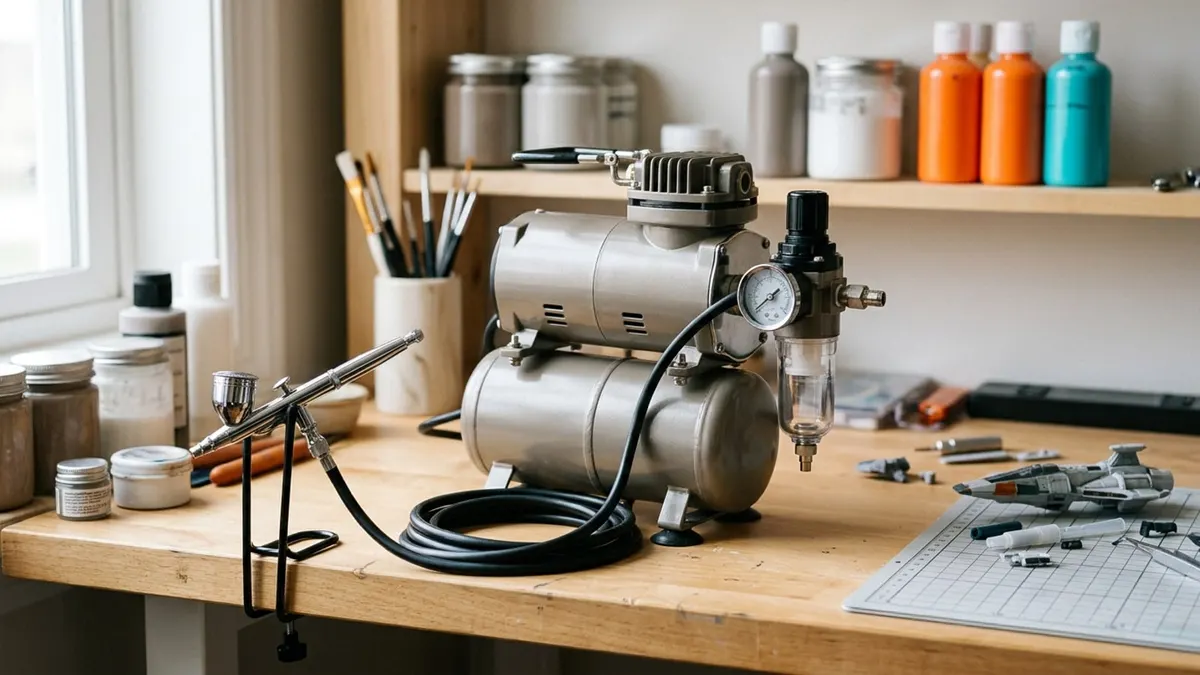
Best Airbrush Compressor of 2026: Tank, Quiet and Portable Models Compared
Five airbrush compressors, from a palm-sized desk unit to Iwata's Smart Jet Pro, picked on pressure, air delivery, tank and noise.
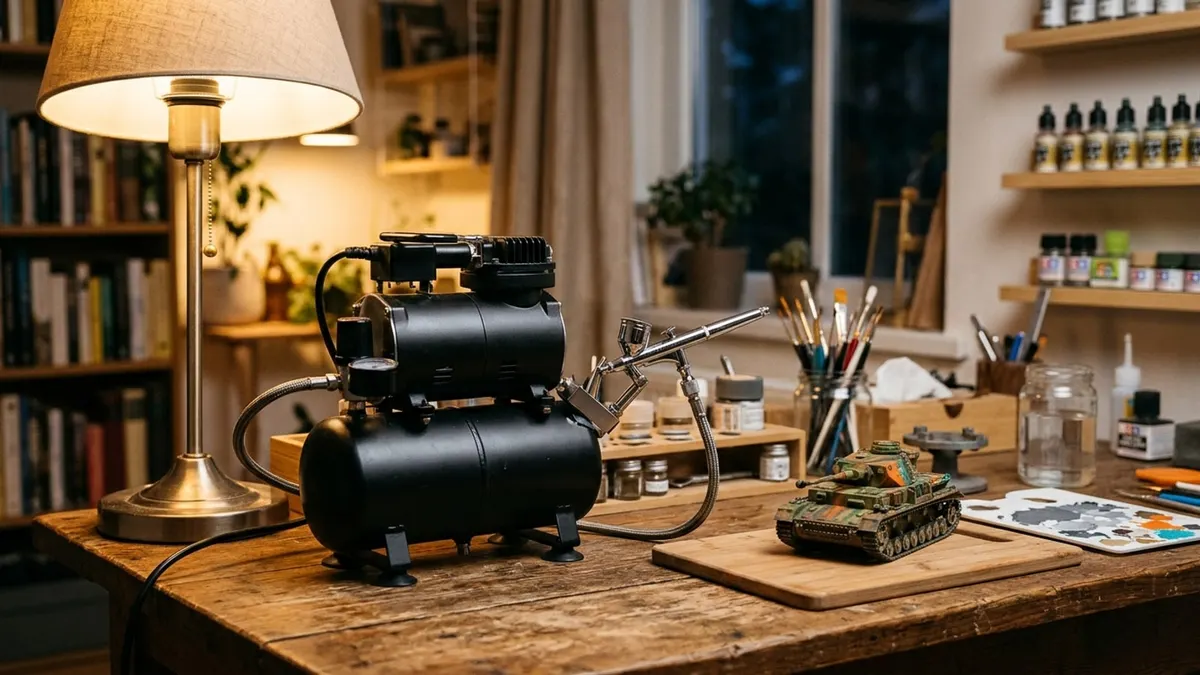
Best Quiet Airbrush Compressor (2026): Low-Noise Models by Decibel Rating
Low-noise compressors for apartments, shared rooms and late-night painting, ranked by the makers' decibel figures, with the catch in how those figures are measured.
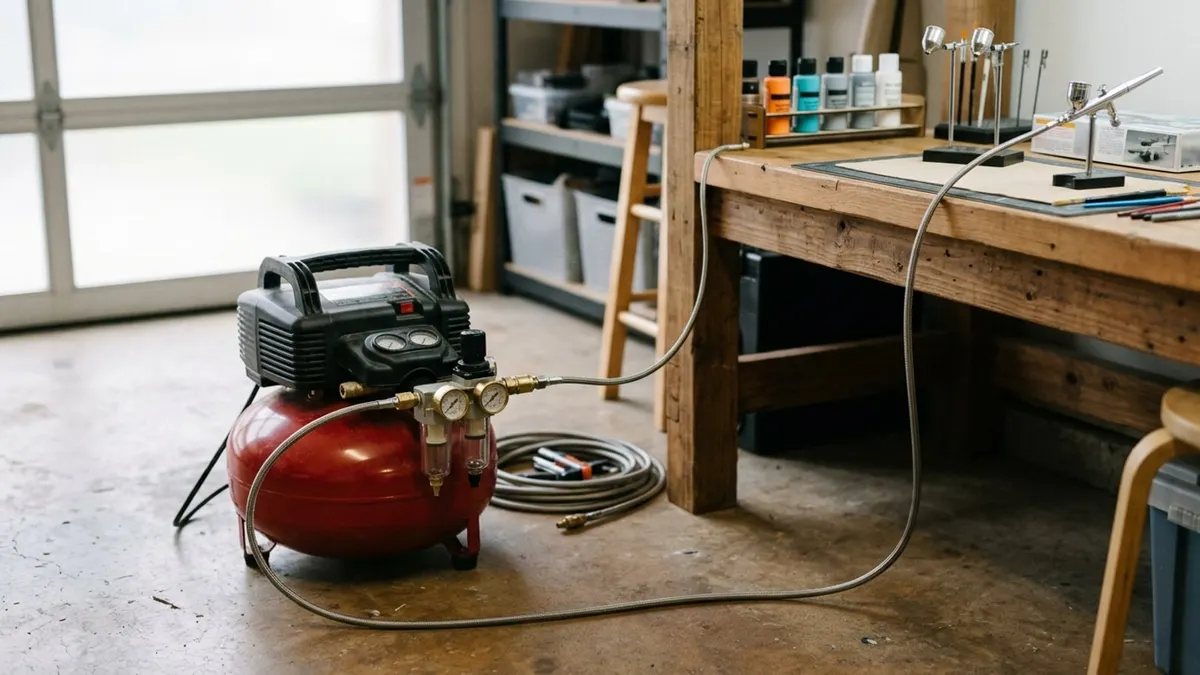
Can You Use a Regular Air Compressor for an Airbrush? Yes, With These Parts
A garage compressor has more than enough air for an airbrush. What it lacks is fine pressure control and clean, dry air. Here is the parts list and setup.