
Can You Use a Regular Air Compressor for an Airbrush? Yes, With These Parts
How to run an airbrush from a regular shop or garage air compressor: the regulator, moisture and oil filtering, hose adapter and pressure settings you need.
Affiliate disclosure: product links on this page go to Amazon, or to the maker's own store for brands that sell only direct. As an Amazon Associate we earn from qualifying purchases, at no extra cost to you; a link to a maker's store earns us nothing. No retailer or brand sees our picks before they are published or has any say in them. How we choose.
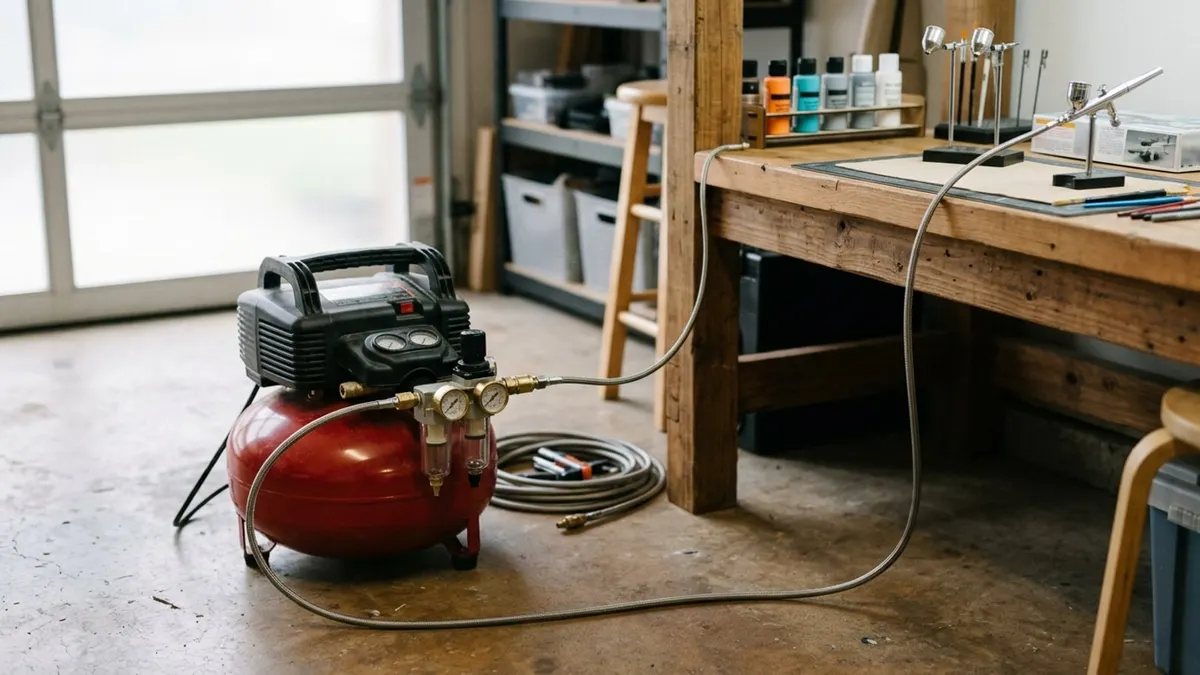
Yes, you can run an airbrush from a regular shop compressor. It has far more air than an airbrush uses: Paasche rates its airbrushes at 0.5 CFM at 20 psi, and a small garage compressor such as the California Air Tools 1P1060S delivers 1.6 CFM at 40 psi (per its listing). What a shop compressor lacks is fine pressure control at 10 to 35 psi and clean, dry air.
Add three things between the compressor and the airbrush: a filter-regulator that removes water (and oil, on oiled compressors), an airbrush-scale regulator with a gauge and its own water trap, and a hose with the right fittings. That is about the price of a bottle of paint, and the setup is below.
The parts list
| Part | Why | Example |
|---|---|---|
| 1. Filter-regulator at the compressor | Drops tank pressure (often 90 to 150 psi) and removes water and oil | NANPU AW2000: 1/4 in NPT, 5 micron element, 0 to 145 psi |
| 2. Airbrush regulator with gauge and water trap at the bench | Fine control in the 10 to 35 psi range, and a last water trap | Master Airbrush TFR-3000: diaphragm regulator up to 100 psi, drain valve |
| 3. Adapter | Shop fittings are 1/4 in NPT; airbrush hoses are 1/8 in BSP | VIAIR 90001: 1/8 in BSP female to 1/4 in NPT male |
| 4. Airbrush hose | Light, flexible, with airbrush fittings | Master 10 ft braided hose: 1/8 in BSP both ends |
| 5. Thread sealant tape | Seals the NPT joints | Iwata advises no more than 3 wraps |
Iwata's own hose shows the standard: the small end (1/8 inch BSP) goes to the airbrush and the larger end (1/4 inch NPT) to the compressor, and non-Iwata compressors without a 1/4 inch fitting need an adapter. Paasche airbrushes use Paasche's own 1/4"-20 thread and ship with a 1/8 BSP adapter.
Setup, step by step
- Fit the filter-regulator to the compressor outlet (or the end of your shop hose), bowl down, and set it somewhat above the highest pressure you spray at, and within the airbrush regulator's rating (Master's TFR-3000 handles up to 100 psi). It takes the bulk of the water and oil out at the source.
- Run your shop hose to the bench and fit the airbrush regulator there, where you can see its gauge while you paint.
- Add the adapter and the airbrush hose. Wrap NPT threads with sealant tape, no more than three wraps (Iwata).
- Set the airbrush regulator to the paint maker's pressure with the trigger held down (air flowing). See the PSI chart.
- Check for leaks with soapy water on each joint, as Iwata suggests: bubbles mean a leak.
- Test with water before paint (Iwata's first rule).
An example setup
| Part | Example | Key figure |
|---|---|---|
| Quiet, oil-free compressor | California Air Tools 1P1060S | 56 dBA, 1.6 CFM at 40 psi (per its listing) |
| Filter-regulator at the tank | NANPU AW2000 | 5 micron element, 0 to 145 psi (per its listing) |
| Airbrush regulator at the bench | Master TFR-3000 | Diaphragm regulator up to 100 psi, water trap with drain (per its listing) |
| Adapter | VIAIR 90001 | 1/8 in BSP female to 1/4 in NPT male |
| Hose | Master 10 ft braided | 1/8 in BSP both ends |
That chain gives you the shop compressor's surplus air with airbrush-scale control at the bench. Paasche rates its airbrushes at 0.5 CFM at 20 psi, so a 1.6 CFM compressor has room for a second airbrush or a small air tool.
Water and oil: the real problem
Compressed air carries water vapor that condenses in the tank and hoses, and on humid days it reaches the airbrush as spits and spots. Shop compressors with large tanks collect a lot of it. Drain the tank after each session and empty both water traps. Master describes its regulator's water trap as catching condensation before it reaches the airbrush, with a drain valve to empty it.
Oil-lubricated compressors also put a fine oil mist into the air, which can spoil paint adhesion; Createx's guide has you clean oils off a surface before painting for the same reason. Use a filter rated for oil as well as water (the NANPU unit is sold as a water and oil separator), or use an oil-free compressor. California Air Tools' 1P1060S, for example, has an oil-free pump (per its listing).
Shop compressor vs airbrush compressor
| Shop compressor + regulators | Airbrush compressor | |
|---|---|---|
| Air supply | Plenty; runs several airbrushes and air tools | Enough for one or two airbrushes |
| Pressure control | Needs an added airbrush regulator | Built in, sized for 0 to 60 psi |
| Water | More condensation; drain often | Smaller tank, built-in trap on most |
| Noise | California Air Tools rates the 1P1060S at 56 dBA; many are far louder | 47 to 62 dB for the models we checked |
| Cost if you already own one | The price of two regulators and an adapter | A new compressor |
If your shop compressor is loud and lives in the garage, run a long hose to a quiet room, or consider a dedicated quiet airbrush compressor; see quiet airbrush compressors and the best airbrush compressors.
Safety
- Never connect an airbrush directly to tank pressure. Airbrush makers rate their tools far lower: Iwata's highest working range is 35 to 55 psi for a siphon airbrush, and Paasche's top rating is 75 psi.
- Release pressure before you change fittings.
- Keep the compressor away from the spray area, especially with solvent-based paint.
- Follow the compressor maker's manual for tank draining and inspection.
Frequently asked questions
Can I use a regular air compressor for airbrushing?
Yes. Add a filter-regulator at the compressor to remove water and oil, an airbrush regulator with a gauge and water trap at the bench, and a 1/8 inch BSP to 1/4 inch NPT adapter for the airbrush hose.
What PSI should I set my shop compressor to for an airbrush?
Set the first regulator somewhat above your highest spraying pressure and within the airbrush regulator's rating, and the airbrush regulator to the paint maker's figure, for example about 15 psi for Vallejo Model Air. Never feed full tank pressure to an airbrush.
What fitting does an airbrush hose use?
Most airbrush hoses use 1/8 inch BSP fittings. Iwata's hose runs 1/8 inch BSP at the airbrush to 1/4 inch NPT at the compressor. Paasche airbrushes use Paasche's own 1/4"-20 thread with an adapter.
Do I need a moisture trap for airbrushing?
Yes, especially with a shop compressor. Compressed air carries water that condenses in tanks and hoses and spits through the airbrush. Use a trap at the compressor and another at the airbrush regulator, and drain the tank after use.
Will an oiled compressor ruin my airbrush paint?
Oil mist in the air can spoil paint adhesion. Use a filter that separates oil as well as water, or an oil-free compressor. California Air Tools' 1P1060S has an oil-free pump, per its listing.
Sources
- Equipment Setup, Iwata-Medea
- Troubleshooting, Iwata-Medea
- Iwata Eclipse HP-BCS (ECL2000), Iwata-Medea
- TG Model (air volume and inlet thread), Paasche Airbrush
- Hard Surface & Automotive Guide (2023), Createx Colors
- Vallejo Model Air color chart (2026), Acrylicos Vallejo
Cover image: Illustration: Airbrush Review (AI-generated)
Related guides
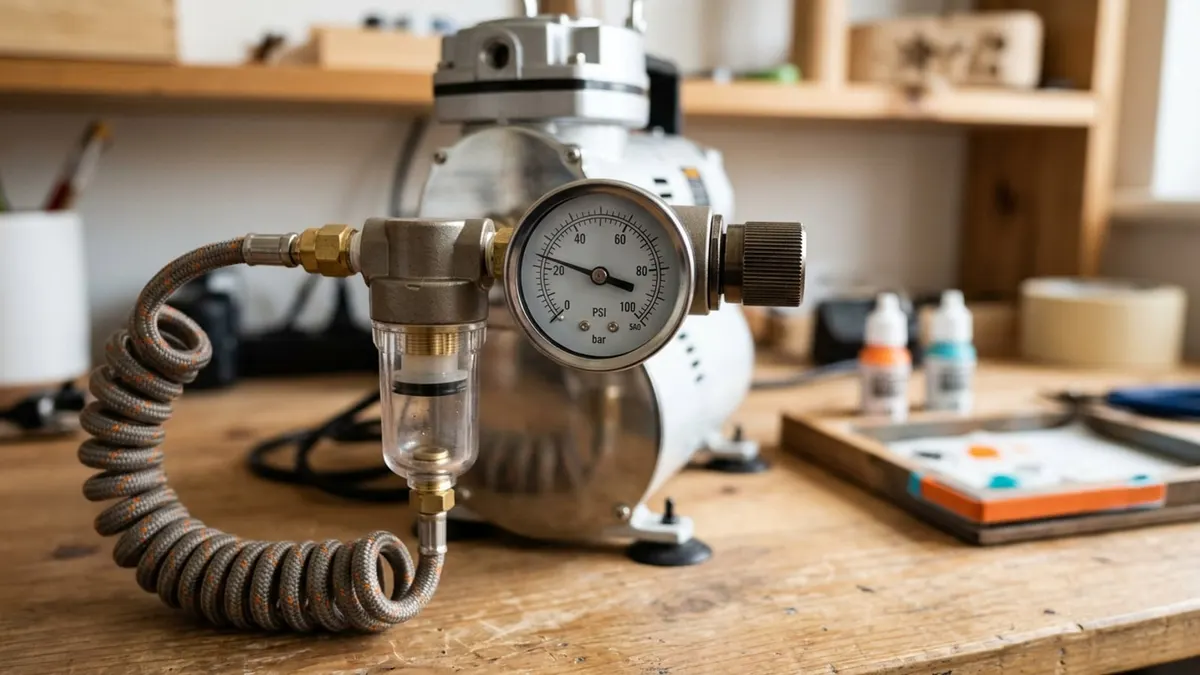
Airbrush PSI Chart: The Pressure Each Paint and Airbrush Maker Recommends
What pressure to airbrush at, by paint and by airbrush, using only figures the makers publish, plus a finder that matches the two.
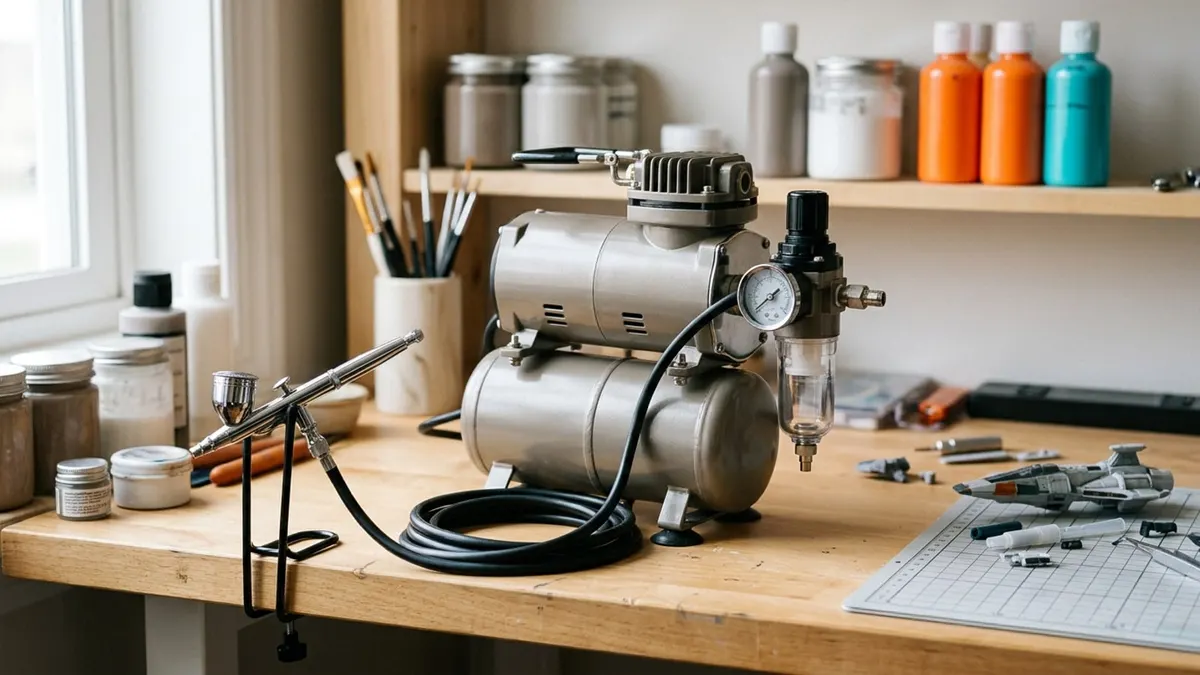
Best Airbrush Compressor of 2026: Tank, Quiet and Portable Models Compared
Five airbrush compressors, from a palm-sized desk unit to Iwata's Smart Jet Pro, picked on pressure, air delivery, tank and noise.
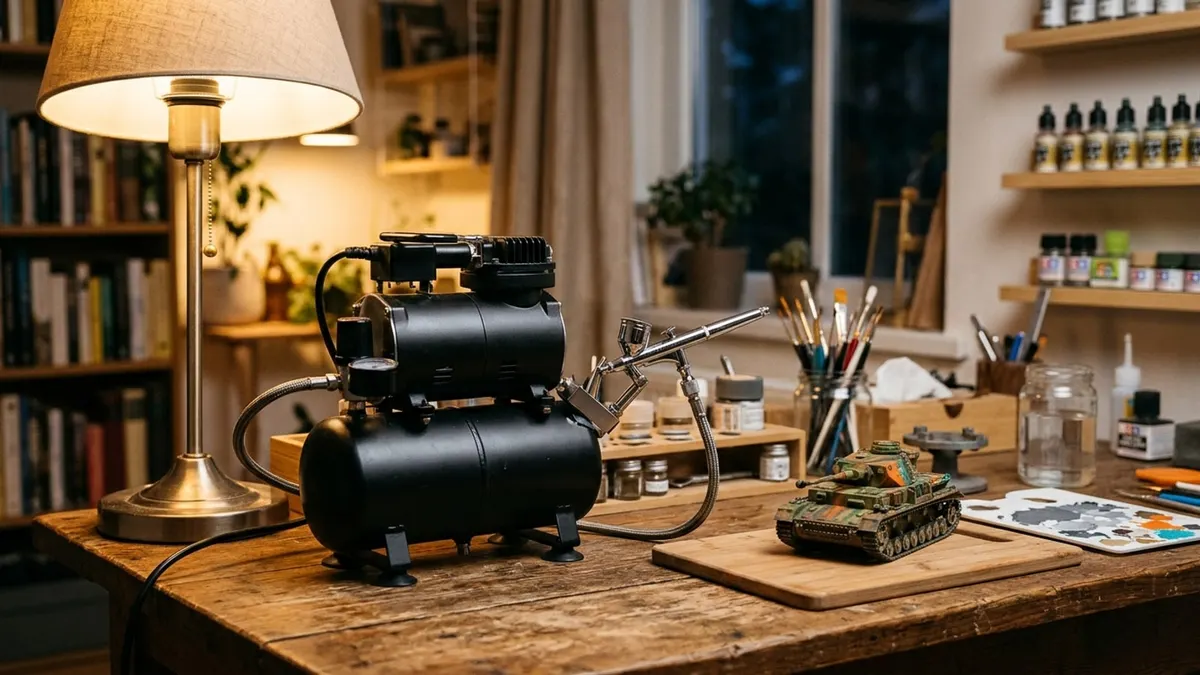
Best Quiet Airbrush Compressor (2026): Low-Noise Models by Decibel Rating
Low-noise compressors for apartments, shared rooms and late-night painting, ranked by the makers' decibel figures, with the catch in how those figures are measured.