
Iwata Eclipse vs NEO: Which Iwata Airbrush Should You Buy?
Iwata Eclipse HP-CS vs NEO for Iwata CN: working pressure, nozzle, cups, compressor needs and price, and which one fits your painting.
Affiliate disclosure: product links on this page go to Amazon, or to the maker's own store for brands that sell only direct. As an Amazon Associate we earn from qualifying purchases, at no extra cost to you; a link to a maker's store earns us nothing. No retailer or brand sees our picks before they are published or has any say in them. How we choose.
Buy the NEO for Iwata CN if you are starting out, use a small low-pressure compressor, and spray thin paints: hobby acrylics, inks, food colors and nail paint. Iwata built it for soft, even coverage at 8 to 20 psi. Buy the Eclipse HP-CS if you want one airbrush for every paint you will meet, including primers, metallics and pearls, and you have a compressor that holds 25 to 35 psi.
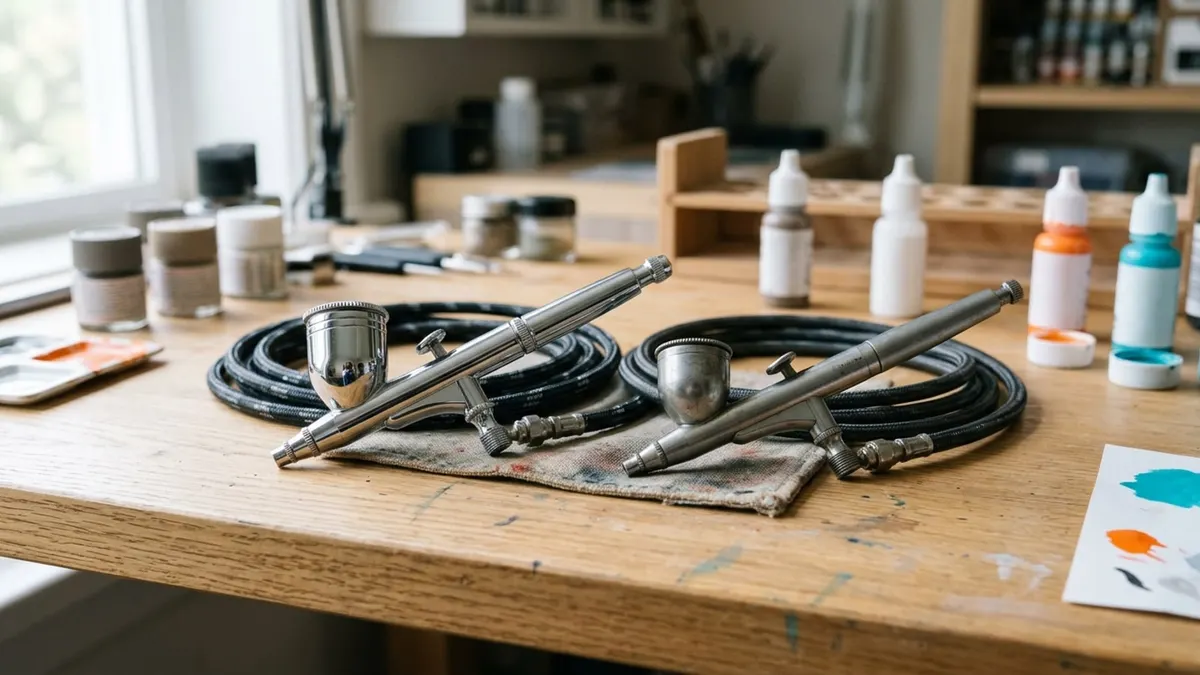
Both are gravity-feed, dual-action airbrushes with a 7 ml cup, so they feel alike in the hand. The differences are the nozzle, the pressure and what each is meant to spray.
The two side by side
| NEO for Iwata CN (N4500) | Eclipse HP-CS (ECL4500) | |
|---|---|---|
| Iwata category | Effortless Coverage | All-Star Versatility |
| Spray scale | Fine to wide (soft coverage) | Fine to wide |
| Optimal working pressure | 8 to 20 psi | 25 to 35 psi |
| Head system | N3, screw-on nozzle | E3, compression-fit nozzle |
| Cups | 7 ml with lid, plus 3 ml | 7 ml with lid |
| Handle | Standard | Single cut (quick flush) |
| Weight | 0.20 lb (0.09 kg) | 0.25 lb (0.11 kg) |
| Iwata list price | $100 | $199 |
From Iwata's product pages, read Nov 8, 2026. Iwata's own store showed the NEO CN sold out that day; Amazon had stock from Iwata-Medea.
Pressure: the difference that decides it
The NEO's 8 to 20 psi and the Eclipse's 25 to 35 psi do not overlap. That decides which compressor you need. Iwata's own beginner kit pairs the NEO with the Ninja Jet, a small compressor that works at 1 to 15 psi; that compressor cannot run the Eclipse in its optimal band. The Eclipse wants something like Iwata's Smart Jet Pro (1 to 30 psi working, 50 psi maximum) or a tank compressor such as the Master TC-326T.
Low pressure has real benefits for the NEO's intended jobs: less overspray, less paint drying on the needle, and quieter, cheaper compressors. Higher pressure is what lets the Eclipse atomize thicker paint without heavy thinning.
Nozzle: screw-on vs compression fit
The NEO's N3 nozzle screws into the body, like most airbrushes. Tighten it gently with the supplied tool; over-tightening is how threaded nozzles crack. The Eclipse's E3 nozzle is a compression fit clamped by the head cap, with no threads at all. Iwata's cleaning guide says to remove the Eclipse head cap with its own wrench and never separate the nozzle from the head set. For beginners who strip their airbrush often, that difference alone can justify the Eclipse.
What each sprays well
| Job | NEO CN | Eclipse HP-CS |
|---|---|---|
| Thinned hobby acrylics (Vallejo Model Air, Createx) | Yes | Yes |
| Inks, food colors, nail paint | Yes, at low pressure | Yes |
| Primers and varnish | Thin them well | Yes, with less thinning (Iwata) |
| Metallics and pearls | Can clog | Yes (Iwata names pearlized materials) |
| Solvent-based paints | Not stated by Iwata | Solvent-resistant packings (per the Amazon listing) |
| Hairline detail | No | Fine lines, not hairline |
Cleaning and maintenance
Both strip down the same way for an end-of-session clean, following Iwata's cleaning guide: disconnect the air, take off the handle, loosen the needle chucking nut, slide the needle out and wipe it from back to front, then remove the caps and nozzle. The difference is the nozzle step.
| Step | NEO CN | Eclipse HP-CS |
|---|---|---|
| Remove the nozzle | Unscrew it with Iwata's nozzle wrench, turning left | Remove the head cap with the supplied head cap wrench; leave the nozzle in its head set |
| Soak | Nozzle and caps, no more than 10 minutes | Nozzle, caps and head cap, no more than 10 minutes |
| Refit | Thread sealer on the threads only; snug, not tight | Seat the nozzle, screw on the head cap, tighten gently |
| Common mistake | Over-tightening the threaded nozzle | Using the nozzle wrench on it (Iwata says it does not fit) |
Iwata's troubleshooting guide lists the same faults for both: bubbles in the cup point to a loose cap or cracked nozzle, spatter to dried paint on the needle tip or paint that is too thick. See how to clean an airbrush for the full routine.
The compressor each one needs
| Compressor | Working pressure (Iwata) | Suits |
|---|---|---|
| Iwata Ninja Jet | 1 to 15 psi | NEO CN at the low end of its range |
| Iwata Smart Jet Pro | 1 to 30 psi (50 psi max) | Both |
| A tank compressor with a regulator (for example Master TC-326T) | Regulated, shuts off at 57 psi (per its listing) | Both, with headroom for primer |
If you buy the NEO now and might move to the Eclipse later, buy a compressor that reaches 35 psi or more from the start. Our compressor guide compares them.
What each costs to run
Both use small wear parts that Iwata-Medea sells separately: needles bend and nozzles crack if dropped or over-tightened, and Iwata suggests keeping a spare needle and nozzle if you airbrush often. The Eclipse's E3 nozzle comes with its head set; the NEO's N3 nozzle and needle are its own parts. Neither needs anything more than cleaner, occasional Iwata Lube on the trigger and needle, and thread sealer on the threads Iwata names.
Who should buy which
- NEO CN: first-time airbrushers, cake and cookie decorators, nail artists, anyone with a small or quiet compressor, and anyone who wants a cheap second airbrush for one color.
- Eclipse HP-CS: scale modelers who prime and varnish, auto and helmet painters, illustrators, and anyone who sprays many kinds of paint on one airbrush. Our HP-CS review covers it in depth.
If neither fits, look at the rest of Iwata's range: the Revolution HP-CR sits between them (20 to 30 psi, $115 list) and the Hi-Line models aim at fine detail. For other brands, see the best airbrush for beginners and Harder & Steenbeck's lineup.
Bottom line
Buy on the compressor you have and the paint you spray. A small, quiet compressor and thin paints point to the NEO; a compressor that holds 25 to 35 psi and a mix of primers, metallics and solvent paints point to the Eclipse. If you are unsure, the Eclipse is the one you are less likely to outgrow, as long as your compressor can feed it.
Frequently asked questions
Is the Iwata NEO worth it?
Yes, for a first airbrush on a low-pressure compressor. Iwata rates it at 8 to 20 psi for soft, even coverage and lists it at $100. It is less suited to thick primers and metallics than the Eclipse.
Is the Iwata Eclipse better than the NEO?
It does more: it handles thicker and pearlized paints with less thinning and has a compression-fit nozzle with no threads. It also needs 25 to 35 psi and costs about twice as much by Iwata's list prices. Better depends on what you spray.
Can I use the Iwata NEO with any compressor?
Any compressor with a regulator that holds 8 to 20 psi steadily will do. Iwata pairs it with the Ninja Jet, which works at 1 to 15 psi. Iwata includes adaptors for Badger, Aztek and Paasche airbrushes with its compressors, so check the fitting if you mix brands.
Which Iwata airbrush is best for miniatures?
For general miniature painting the Eclipse HP-CS handles primers, base coats and metallics well. For fine detail Iwata points to its Hi-Line and Custom Micron models. The NEO suits base coats and soft blends on a budget.
Sources
- NEO for Iwata CN Gravity Feed Dual Action Airbrush (N4500), Iwata-Medea
- Iwata Eclipse HP-CS Gravity Feed Dual Action Airbrush (ECL4500), Iwata-Medea
- Learn the 5 Ways to Spray, Iwata-Medea
- Airbrush Cleaning, Iwata-Medea
- Iwata Beginner Airbrush Kit with NEO CN (IW125), Iwata-Medea
- Iwata Revolution HP-CR (R4500), Iwata-Medea
- Airbrush Basics, Iwata-Medea
- Troubleshooting, Iwata-Medea
- Iwata Smart Jet Pro (IS875), Iwata-Medea
Cover image: Illustration: Airbrush Review (AI-generated)
Related guides
Airbrush Types Explained: Dual vs Single Action, Gravity vs Siphon Feed
The four choices that define an airbrush, explained with the makers' own figures, and the type that suits each kind of painting.
Best Airbrush for Beginners (2026): Five Starter Airbrushes Compared
Five first airbrushes, from a $40 three-nozzle set to Harder & Steenbeck's own beginner model, with the compressor each one needs.
Best Airbrush for Miniatures (2026): Detail, Base Coat and Budget Picks
Five airbrushes for painting 28 mm figures and larger, from a 0.25 mm titanium detail airbrush to a two-nozzle budget set, with the paint and pressure to use.